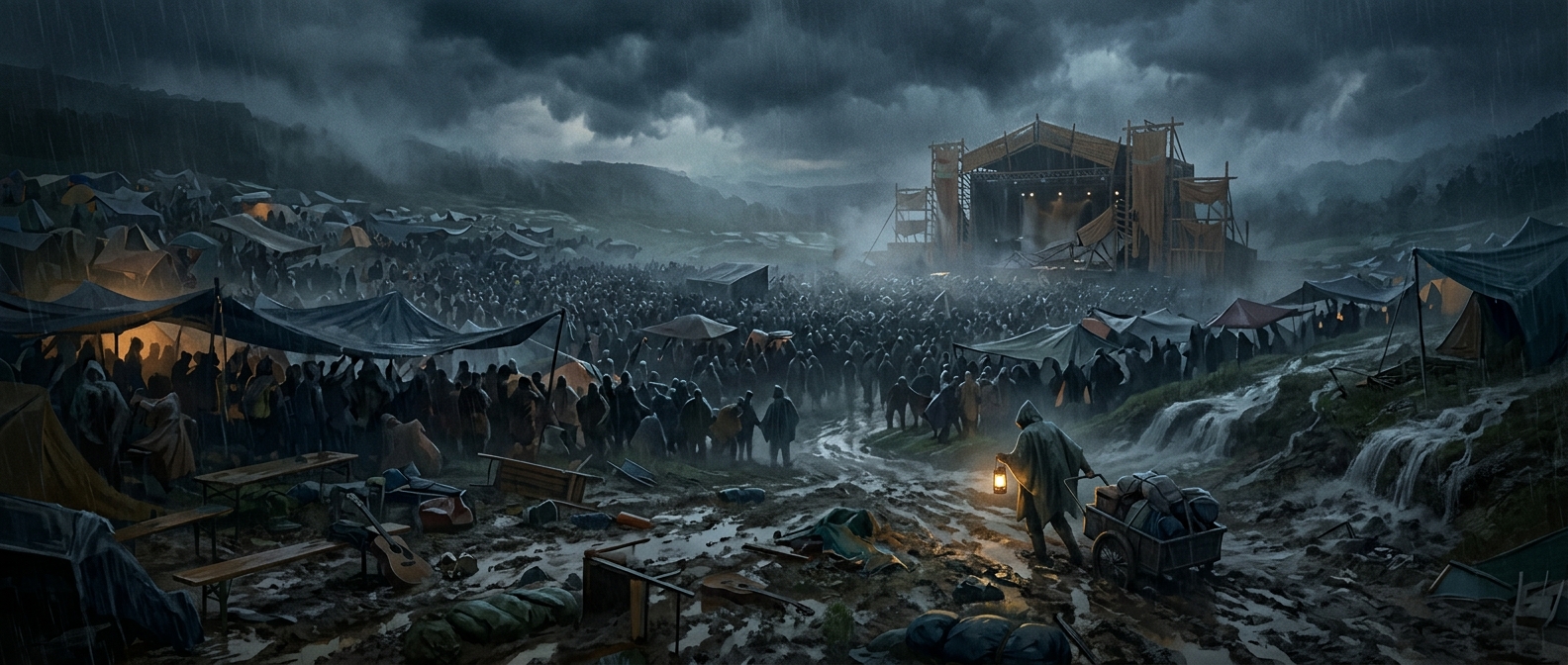
How Woodstock’s crowd outgrew its infrastructure
Woodstock was planned as a ticketed festival at a rural site, where roads, toilets, food service, and fencing all had finite capacity. When far more people arrived than organizers had prepared for, those systems failed together rather than one at a time. Fences came down, and the event effectively lost the boundary that was supposed to control entry. The crowd kept growing while the facilities remained sized for a much smaller gathering.
A chain reaction in the fields
Rain turned the ground into mud, and thousands of people moving across the same fields churned it further. Meanwhile, traffic jams made it difficult to reach the site. That left organizers with a practical problem beyond moving the audience: getting food and other supplies through roads crowded with festivalgoers and stranded vehicles.
The toilets faced the same mismatch. They could not serve a crowd that had expanded beyond the event’s plans, so lines and sanitation problems became part of the experience. Each shortage made the site harder to manage, while the muddy, congested conditions made ordinary fixes—bringing in supplies or directing people—more difficult.
The legend and the logistics
Woodstock’s later image as a defining music gathering can make the disorder seem like mere scenery. But the mud was also evidence of a basic logistical collapse: a rural festival had become too large for its roads, facilities, and supply arrangements. The striking detail is that the crowd’s size changed not just how many people watched the performances, but whether the site could keep food, sanitation, and movement functioning at all.