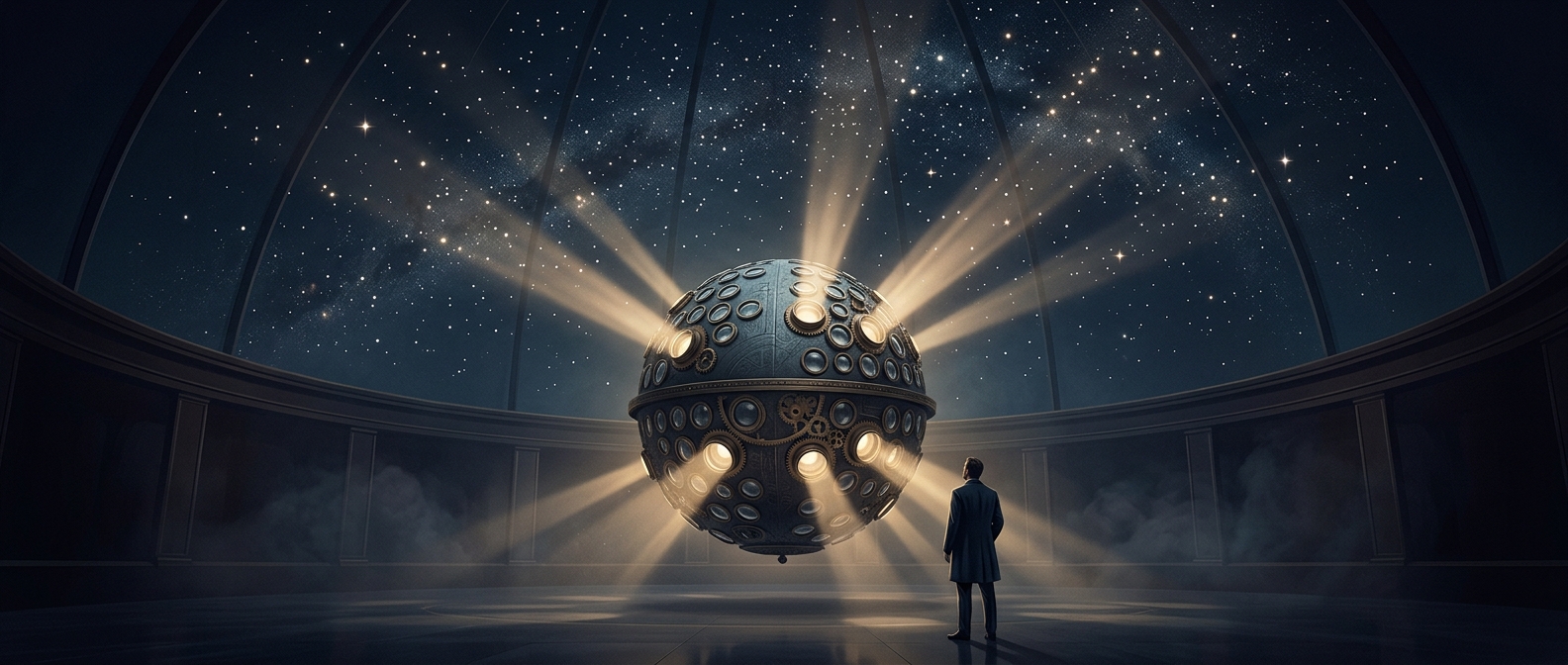
How a metal sphere becomes a night sky
Inside a traditional planetarium projector, a lamp shines through tiny openings in an optical plate. Each opening acts as a carefully positioned point of light: its location corresponds to a star’s position in the sky. Lenses direct those points outward, spreading the pattern across the curved dome above the audience.
The openings are not all identical. Their sizes and optical arrangements help produce stars with different apparent brightnesses, so the display looks less like a grid of equal dots and more like a varied sky. The projector’s many components must hold these tiny points in precise alignment; even a small shift could put stars in the wrong places.
Why the projector moves
The heavy, paired-sphere assembly—often called a star ball—can be turned by gears to change the sky’s orientation. That lets the projected stars appear to move as Earth rotates, or lets an operator demonstrate how the sky changes with time and viewpoint. The gears make that motion controlled and repeatable rather than requiring the projector to be repositioned by hand.
This approach creates the sky optically, with light passing through physical patterns rather than being drawn pixel by pixel on a screen. Its weight and intricate mechanism are part of the tradeoff: the apparatus is bulky, but it can project a sharply organized field of stars across a dome, where the audience can look up and see the sky surrounding them.