Why the Workhouse Was Made Hard to Choose
For poor people in Victorian Britain, a workhouse was not simply a place offering food and a bed. It was part of a public system for deciding who would receive aid. Local authorities administered relief under the Poor Law, and officials increasingly treated support inside an institution as a test: if conditions were worse than the life of the lowest-paid independent worker, they reasoned, people would seek help only when they had no alternative. This principle was known as “less eligibility.”
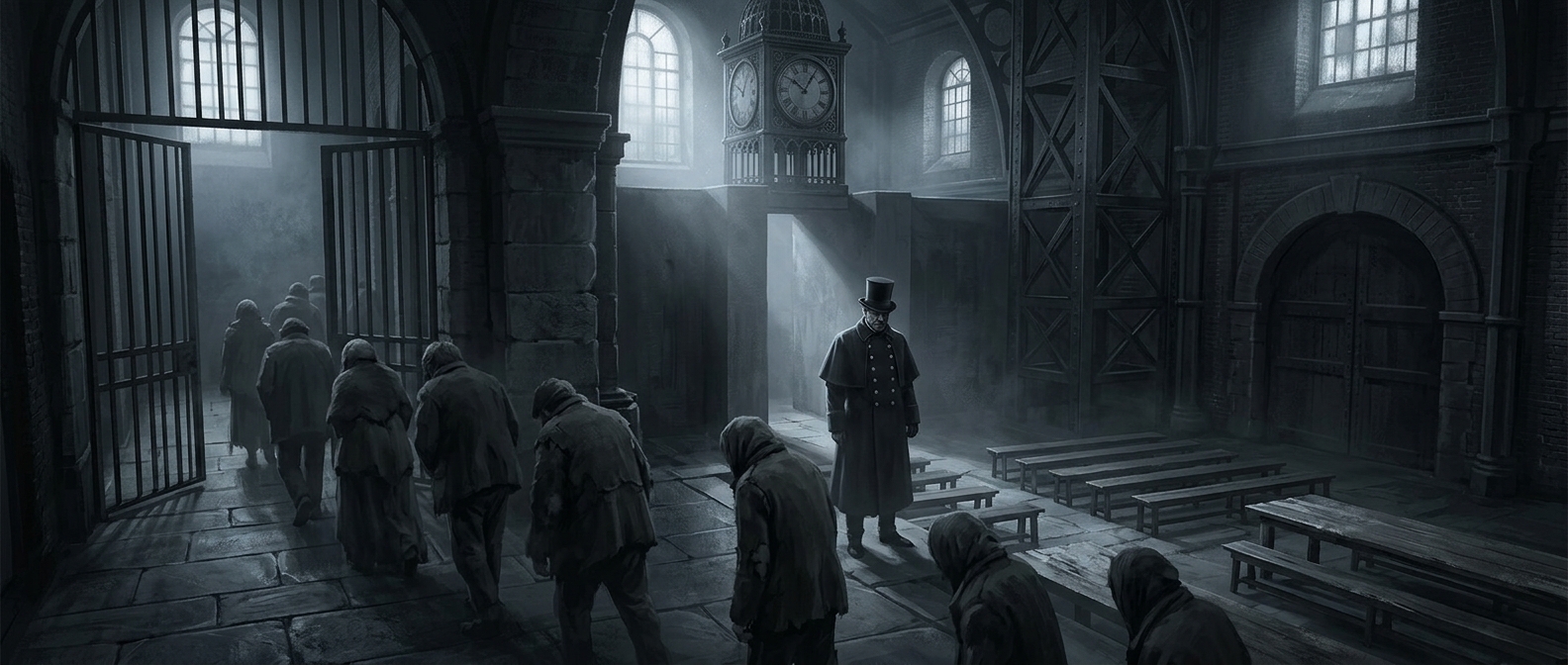
That logic shaped daily routines. Residents lived by rules set by the institution, with work, meals, and movement organized by officials. The labor was not mainly intended to train people for a particular trade; it made relief feel conditional and helped distinguish the “deserving” poor, as authorities defined them, from those they suspected of idleness.
How Rules Reached Into Family Life
Workhouses also sorted residents into categories such as men, women, children, and older people. Separating groups made supervision and administration easier, but it could break up family life just when households were most vulnerable. A parent might have to accept institutional aid knowing that ordinary contact with children would be restricted by the house’s routines.
Conditions were not identical everywhere: local authorities ran their own institutions, and rules and circumstances varied. But the system’s central tension remained. It offered shelter and food while making that help deliberately unattractive. The workhouse door therefore marked more than a boundary between indoors and outdoors: crossing it could mean surrendering control over one’s daily schedule, work, and family contact in exchange for survival.