A nuclear explosion is a chain of coupled processes
A nuclear weapon’s detonation unfolds too quickly and under conditions too extreme to observe in full detail. The initial reactions release energy, which heats and compresses surrounding material; that changing pressure and temperature then affect how the reactions proceed. Radiation, moving matter, and nuclear reactions all influence one another.
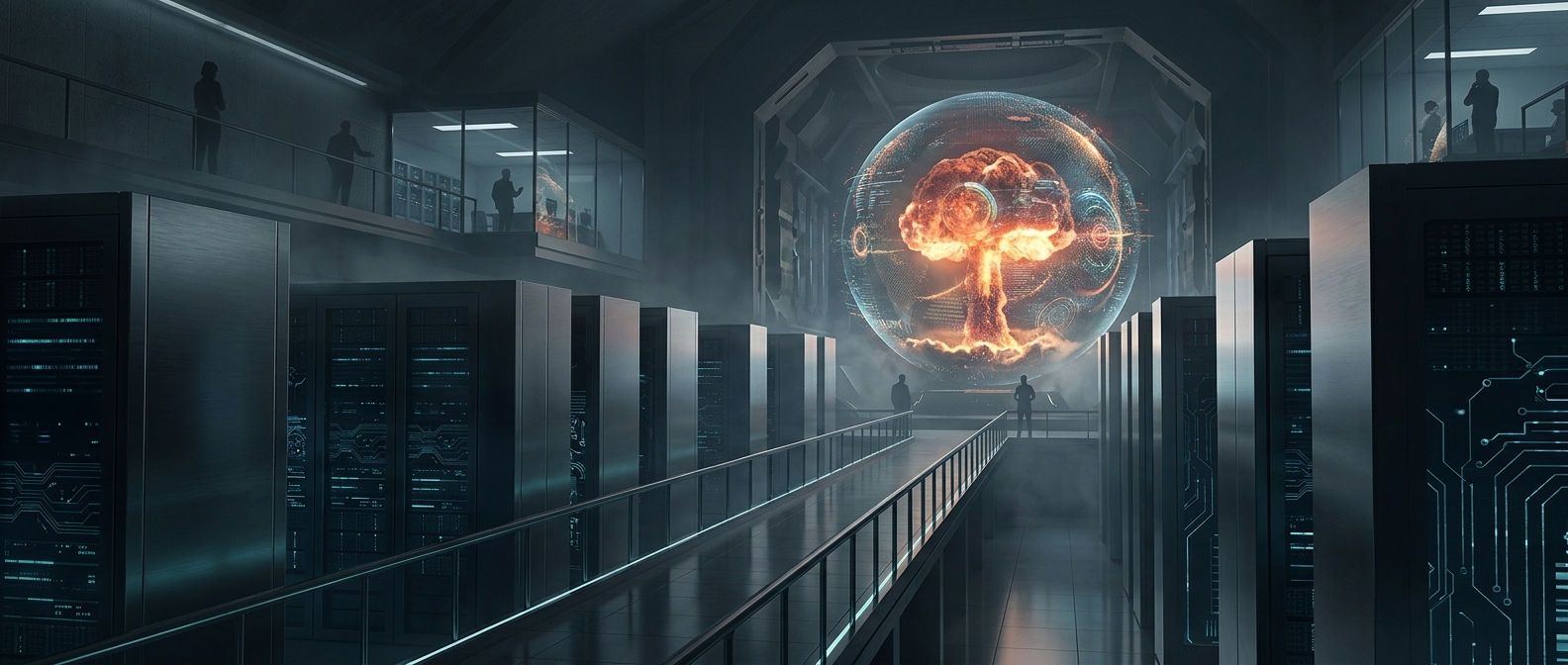
A simulation represents these processes with mathematical models. The computer calculates how conditions change across small regions of space and short intervals of time, passing results between models as the simulated event develops. Because a small change in one process can alter the others, the calculation is far more demanding than simply tracing a single chain of events.
Why the calculations need supercomputers
The simulation must track many interacting quantities across a vast range of conditions. A supercomputer can divide portions of the calculation among many processors, which work at the same time and exchange results. This makes it possible to run detailed models that would be impractical on an ordinary computer.
The goal is not merely to produce a dramatic animation. Governments use these calculations to assess whether weapons will behave as expected and how their performance may change as components age. The results depend on how well the models describe the underlying physics, so simulations are checked against existing test information and experiments that do not involve a nuclear explosion.
Testing the weapon without detonating it
With physical nuclear testing barred by international agreements, simulation provides a way to investigate questions that once could be answered by detonations. It cannot make the real event observable or remove uncertainty; instead, it combines established evidence with models of conditions that cannot be recreated all at once in a laboratory.
That is the central tradeoff: rather than setting off a weapon to learn what happens, researchers use computing power to connect many pieces of physical evidence into a prediction—and examine how that prediction changes when their assumptions do.