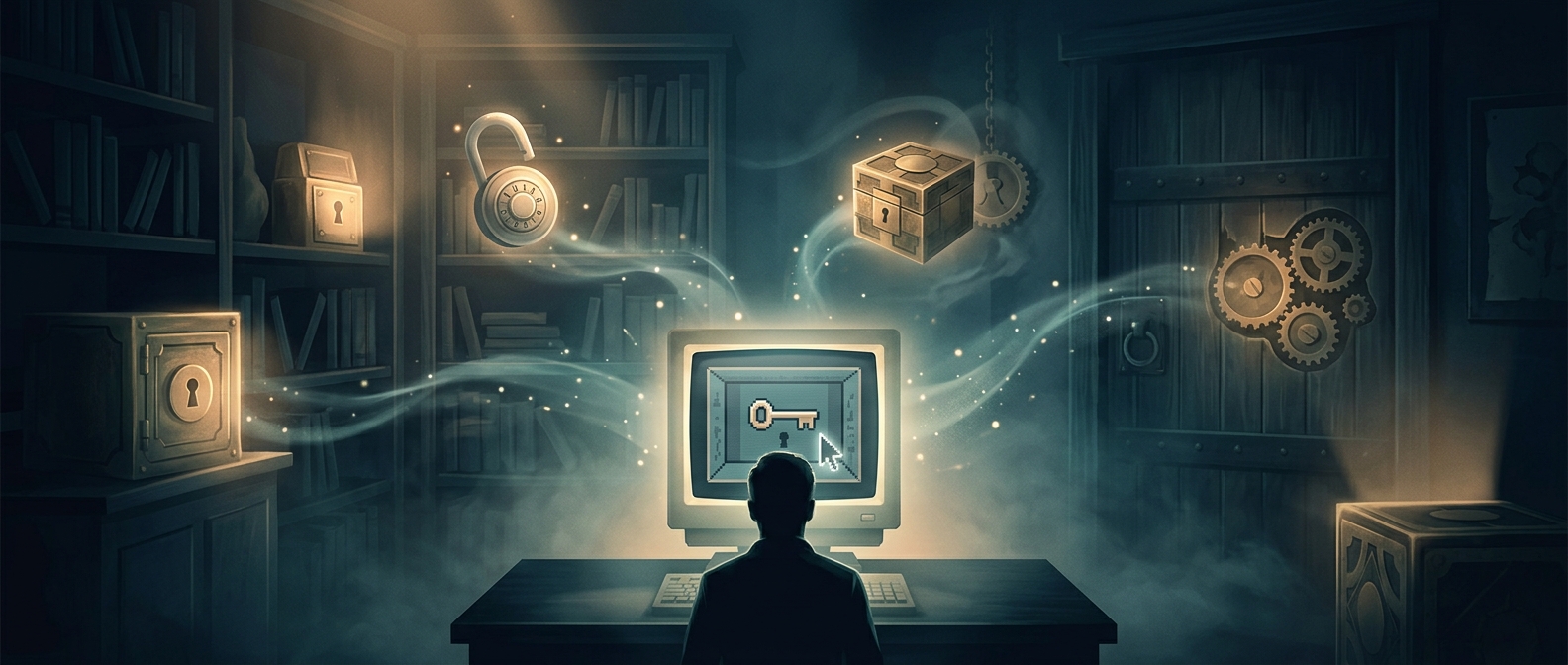
From clicking through a room to searching inside one
Early point-and-click browser games made a room into a puzzle board. Players scanned a still image, clicked suspicious details, and collected objects that might unlock another part of the scene. A key could be visible but easy to miss; a clue might only make sense after the player found a second item. Progress came from noticing, testing, and connecting.
Escape rooms carried that logic into physical space. Instead of clicking a pixel, players inspect a drawer, turn over a prop, or examine a pattern on the wall. Instead of dragging an item onto a lock on-screen, they try a real key or enter a code. The basic loop—search, find, interpret, use—still works, but now several people can investigate at once and share what they notice.
The room has to behave like a game
A browser game can hide an object behind a click target and quietly prevent players from breaking anything. A physical room has to make its clues discoverable without making every object a puzzle. Designers must signal what is worth investigating, arrange puzzles so teams can make progress, and provide a way to reset the room for the next group. The challenge is to preserve the satisfying feeling of discovery while keeping the experience legible and playable in real space.
That shift also changes the role of a missed clue. On a screen, a player can methodically click every pixel; in a room, time pressure and competing searches can make the same clue harder to spot. A well-designed escape room therefore does more than reproduce a browser game’s objects: it turns solitary clicking into a shared search, where one player’s observation can become the whole team’s next move.