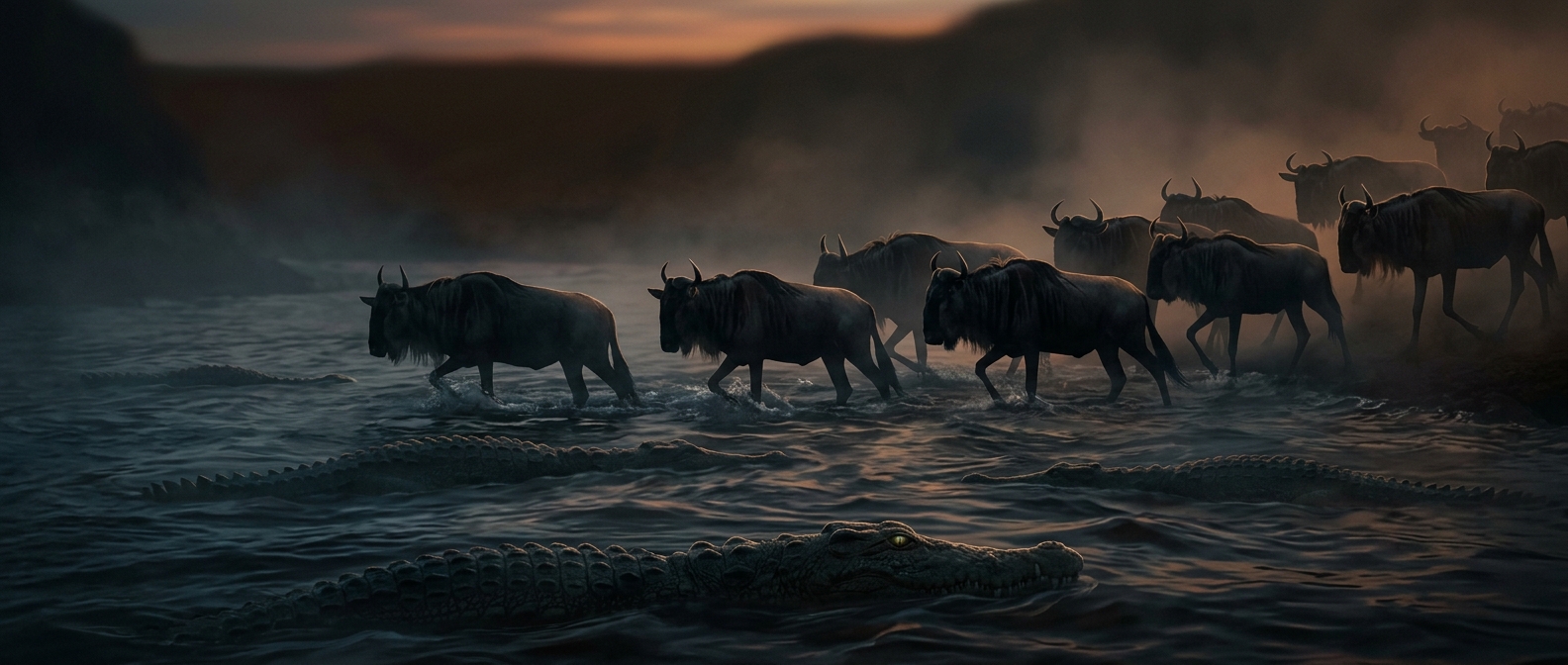
Why the herd reaches the river
Across Tanzania’s Serengeti, wildebeests move in response to seasonal rain. Rain brings fresh grass, but grazing does not stay in one place: as animals feed and conditions change, the herd keeps traveling toward better pasture. A river can lie directly across that route, turning a search for food into a dangerous bottleneck.
The crossing is not a planned gamble by a single leader. Animals respond to the moving herd, and once many begin entering the water, those behind may follow. The result can be a dense rush in which individuals have little room to choose where to step or how to avoid others.
Several hazards combine in the water
Crocodiles can attack from below or near the bank, but they are only one part of the danger. A strong current can carry an animal away from the shallow crossing, while the pressure of other bodies can knock it off balance or hold it underwater. Even an animal that avoids a predator may be injured in the crush.
That combination makes a crossing hazardous in a way that is difficult for any one wildebeest to control. The herd’s movement can help keep animals traveling toward the next feeding grounds, but it does not make the river safe.
The cost of staying put
The risk has to be understood against the alternative: remaining where grazing is dwindling while better grass lies beyond the obstacle. Wildebeests do not need to assess that tradeoff consciously for it to shape their movement. Seasonal conditions pull the herd onward, and the river becomes a point where hunger-driven migration meets immediate physical danger.