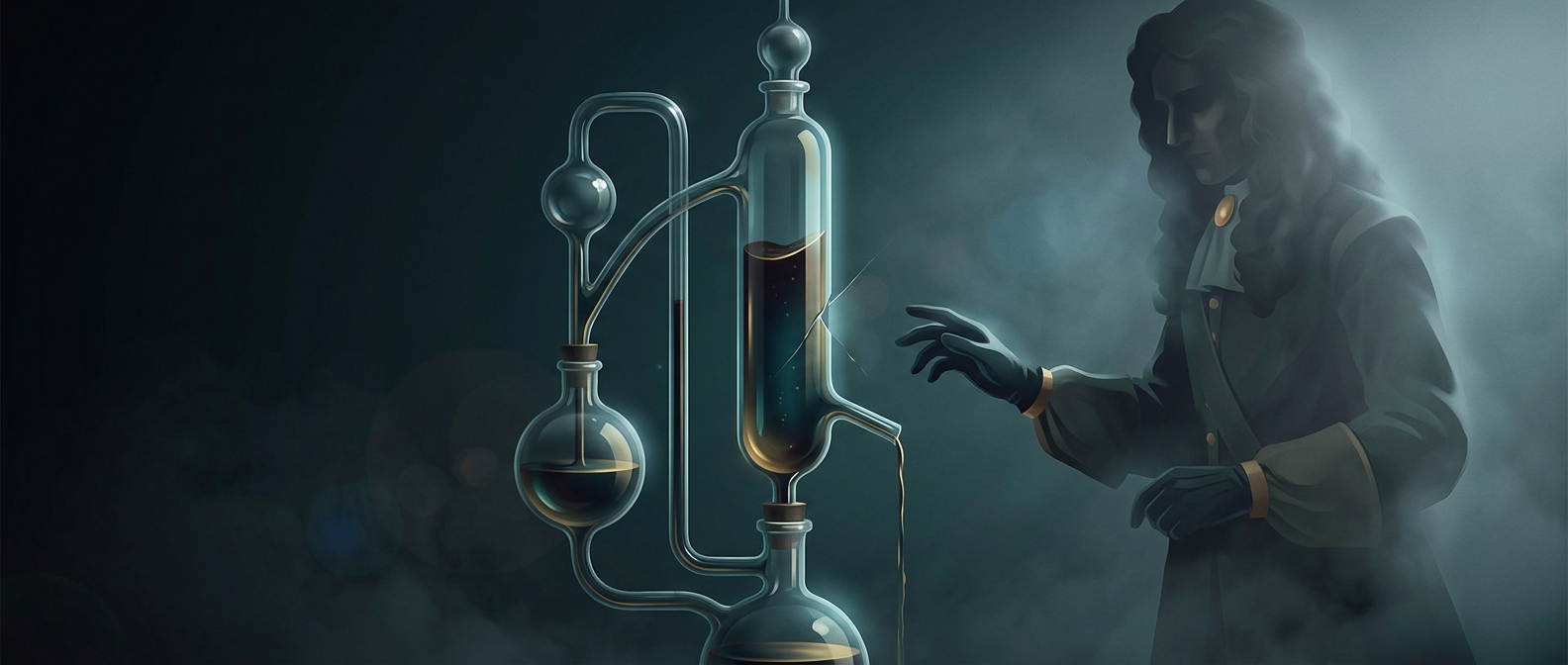
Why Boyle’s Flask Can Lift Liquid but Not Keep Pouring
The trick depends on capillary action: a liquid’s ability to creep through a narrow space. In a glass tube, water molecules are attracted to the glass and spread along its inner wall. Surface tension—the pull that makes a liquid surface behave somewhat like a stretched skin—helps draw the rest of the liquid upward, shaping its surface into a curve called a meniscus.
This is not suction from an endless hidden source. The liquid climbs only while the upward pull at the tube’s surface can support the weight of the rising column.
The Climb Has a Natural Limit
As liquid rises, the column gets heavier, and gravity pulls it downward. Eventually, the column’s weight balances the upward effects of attraction to the glass and surface tension. At that point, the liquid stops rising. A narrower tube can support a taller column because the upward pull along its rim is large relative to the amount of liquid that must be lifted—but the height remains finite.
That balance is what makes the flask look like a tiny fountain with a built-in cutoff. The tube can move liquid against gravity, but it cannot keep delivering more indefinitely: once the forces balance, the apparent magic ends with the liquid held in place.