A body built for a sideways stride
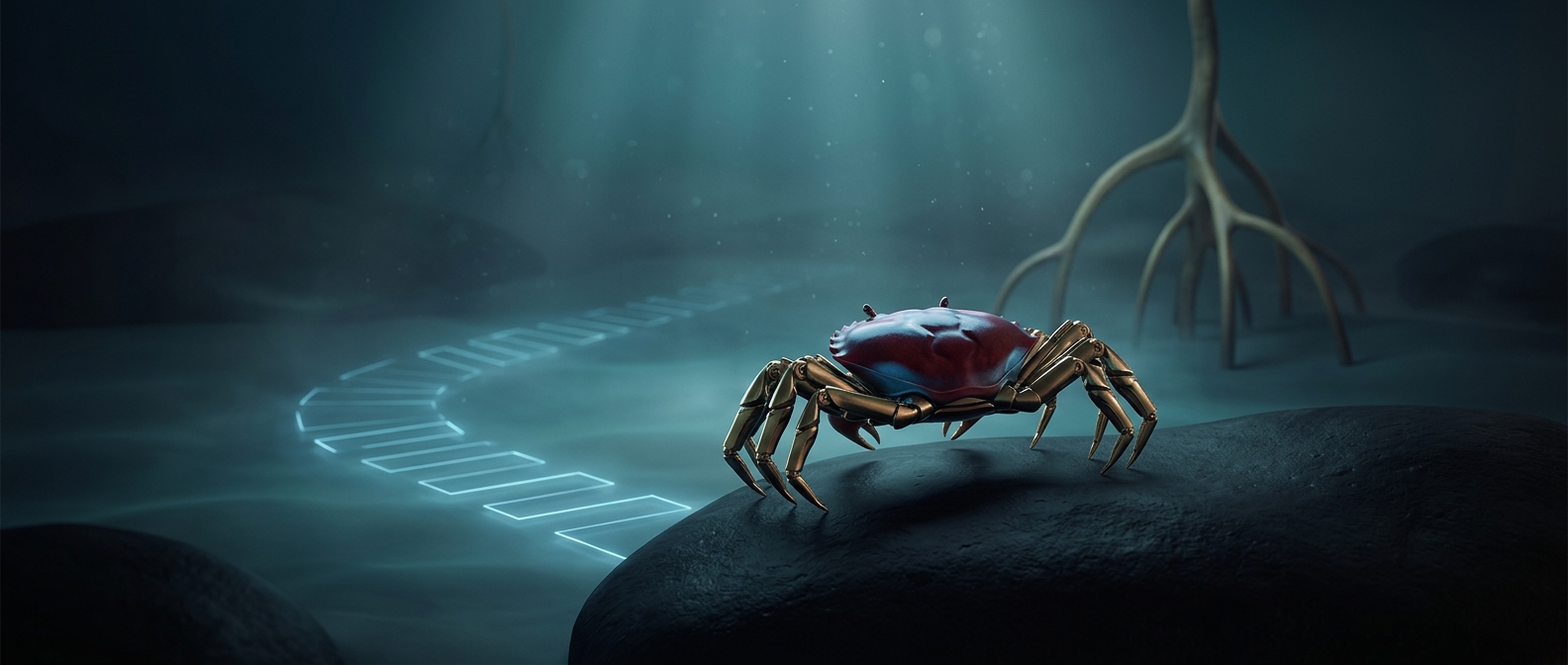
A crab’s legs attach along the sides of a wide, flattened body. Their joints are arranged so the legs swing most freely outward and inward, rather than sweeping neatly forward and back. That makes a sideways step the easiest way to move the body along: one set of legs reaches in the direction of travel while others push against the ground.
The crab’s gait is coordinated rather than a simple shuffle. Legs on alternating sides take turns stepping and bracing, keeping the body supported as it moves. A sideways path can also help a crab slip quickly into a nearby crevice without turning its broad shell around first.
Sideways is the default, not a rule
The familiar scuttle reflects the mechanics of many crabs, but it is not the only possible gait. Some crabs can move forward more readily, depending on their body shape and leg arrangement. Even for a sideways-walking crab, the direction is a practical match between how its joints bend and how its legs can push—not a behavior it has to learn.
So when a crab darts across the sand, it is following the path its body makes easiest: its legs do not need to pivot into a forward-facing stride first.