Why Mario 64 needed a camera character
In a side-scrolling game, the screen can simply show a fixed slice of the level: Mario moves across it, and the player judges jumps from a familiar side view. Super Mario 64 put Mario in a three-dimensional space, where he could run toward or away from the viewer. A fixed viewpoint would hide parts of the course or make distances hard to judge, so the camera had to move as he did.
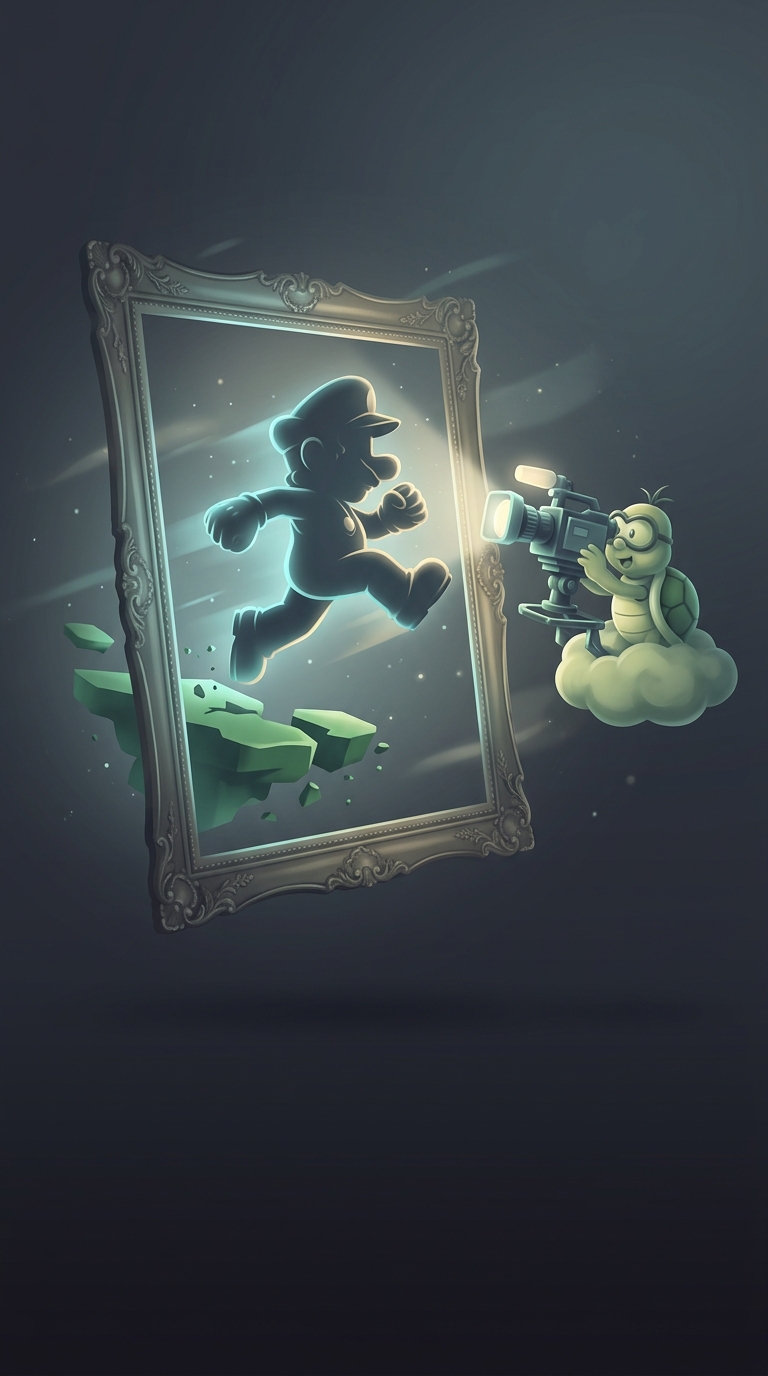
The game gives that invisible camera an in-world operator: Lakitu, the cloud-riding character who holds a camera. It is a playful way to make a technical necessity feel like part of the adventure. Instead of treating the viewpoint as an unexplained window, the game suggests that someone is following Mario and filming him.
Turning camera movement into a play decision
The camera is not just along for the ride. Players can adjust the view, choosing an angle that helps them line up a jump, see around a corner, or inspect a platform. That creates a new kind of challenge: success depends not only on steering Mario, but also on making sure the camera shows enough of the space to steer him well.
The fiction also makes the camera’s limits easier to accept. A camera moving around a real obstacle might lose sight of its subject; in the game, Lakitu can end up behind a wall, leaving the view awkwardly blocked. A problem that might feel like a technical glitch becomes a consequence of the imagined cameraman’s position. In a game built around exploring depth, even the viewpoint becomes part of the world—and part of the player’s task.