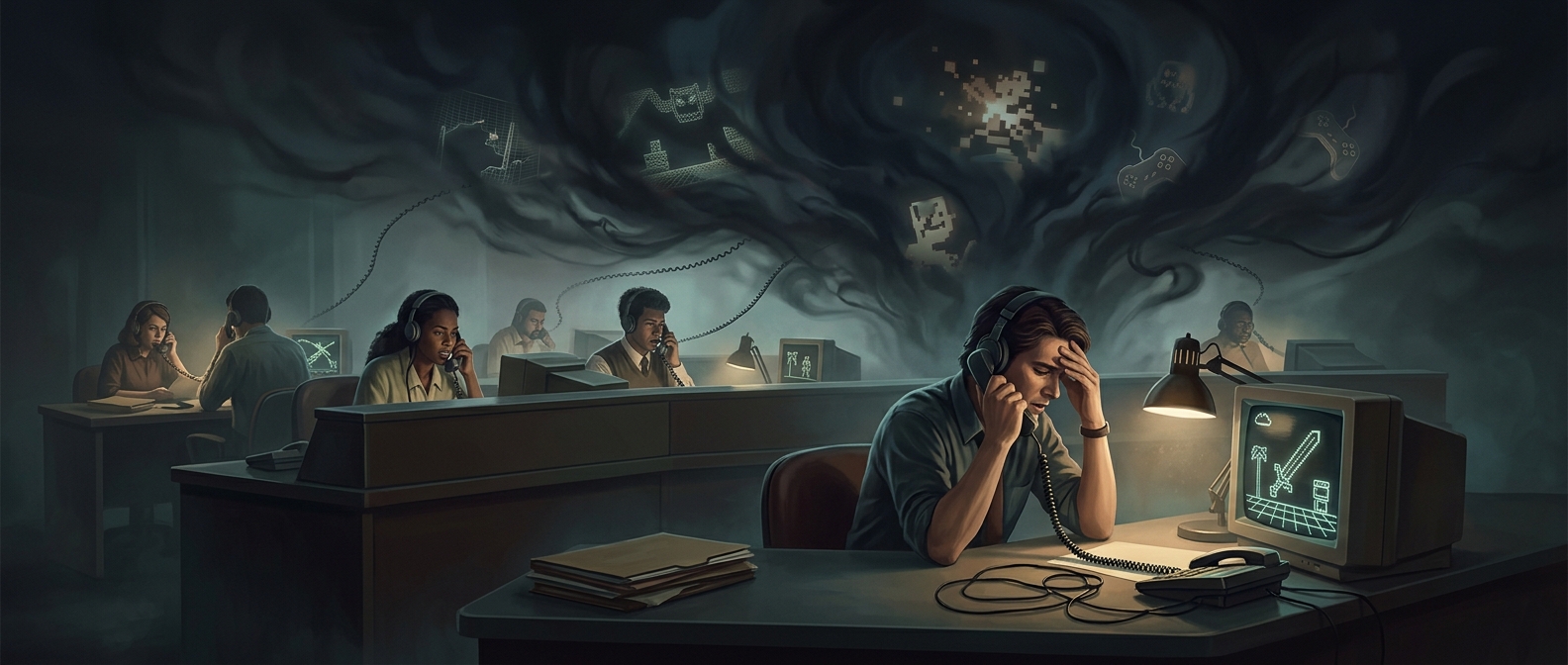
A game problem became a family problem
A child stuck on a level could turn a video game into a household emergency. The parent might hear frustration from across the room, pick up the phone, and call for help—only to discover that the obstacle was not obvious from the outside. A small enemy on-screen could demand precise timing, a particular button, or a better understanding of how the game’s rules worked.
That gap mattered. Adults who had not played the game might see a turtle and assume it was just something to jump over. The child, meanwhile, could be losing repeatedly because the enemy moved in a way they had not learned to anticipate, or because the controls were unfamiliar.
The helper had to teach through a description
A hotline worker could not take the controller or point at the screen. They had to translate a distant, often hurried account into useful instructions: what the player was seeing, what happened after a button press, and where the attempt went wrong. Then they had to explain a solution clearly enough for someone else to try it in real time.
That made game support a form of live troubleshooting. The helper was not merely giving away an answer; they were helping a parent understand a system the child was already learning by trial and error. The parent became a go-between for the game and the player.
The turtle was a lesson in how games teach
Games often teach through action rather than a manual: try a move, see what happens, and adjust. That works when a player recognizes the pattern. It is much less helpful when a child is stuck and an adult cannot tell what the screen is asking them to do.
So a call about one stubborn enemy could involve two lessons at once—how to get past it, and how the game’s logic worked. The memorable part was not just that a parent needed help with a turtle; it was that the person on the phone had to make an invisible set of game rules understandable from across the line.