A thunder god, translated into fighting-game rules
Raiden’s divine status gives Mortal Kombat a striking visual contrast: a supernatural protector can be matched against fighters whose power comes from training, weapons, or sheer toughness. But a fighting game cannot let one character’s story role decide every match. Players need opponents to have a chance, and each fighter needs actions that can be answered and countered.
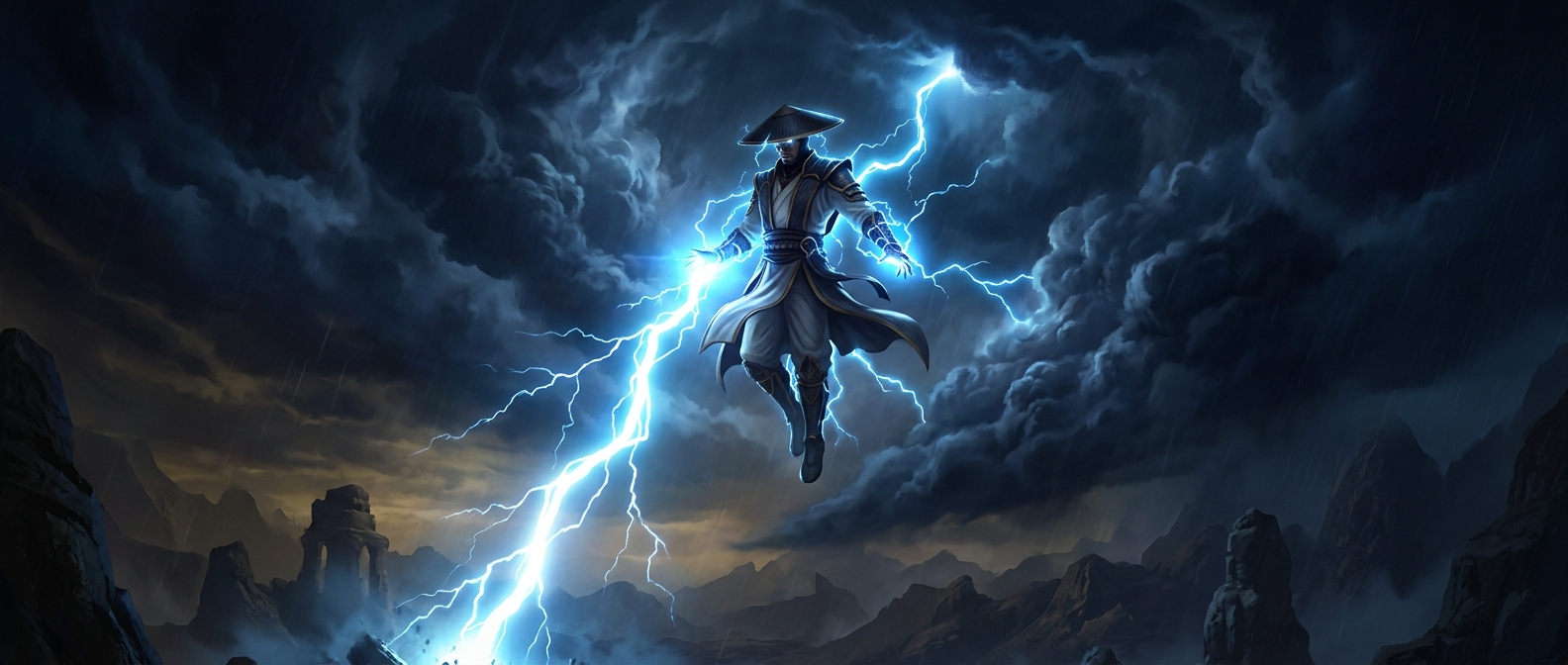
The solution is to express godhood through distinctive moves, not automatic victory. Raiden’s lightning and sudden movement make him feel different from a conventionally trained fighter, while the game’s shared rules keep those abilities inside a contest both players can understand. A lightning attack can threaten space; a teleport can change where Raiden appears. Neither makes an opponent untouchable or removes the need to choose the right moment.
Mythic scale, human-sized decisions
That balance also shapes how the fights read on screen. Raiden may command thunder, but his opponent can still block, evade, and strike back. The exchange becomes less a test of who has greater cosmic power and more a sequence of decisions: when to press an advantage, when to defend, and how to respond to an unusual attack.
This is a familiar design tradeoff in a roster built around wildly different characters. If Raiden’s divine power were portrayed as overwhelming in every encounter, there would be little room for a competitive fight. If it were merely decorative, he would lose the identity that makes him Raiden. The game keeps both ideas in play: his powers define his style, while the rules preserve the possibility of a fair match.
That is why a thunder god can plausibly face an ordinary human in hand-to-hand combat—not because the fiction makes them equally powerful, but because the game turns a huge difference in lore into a contest of readable, limited moves.