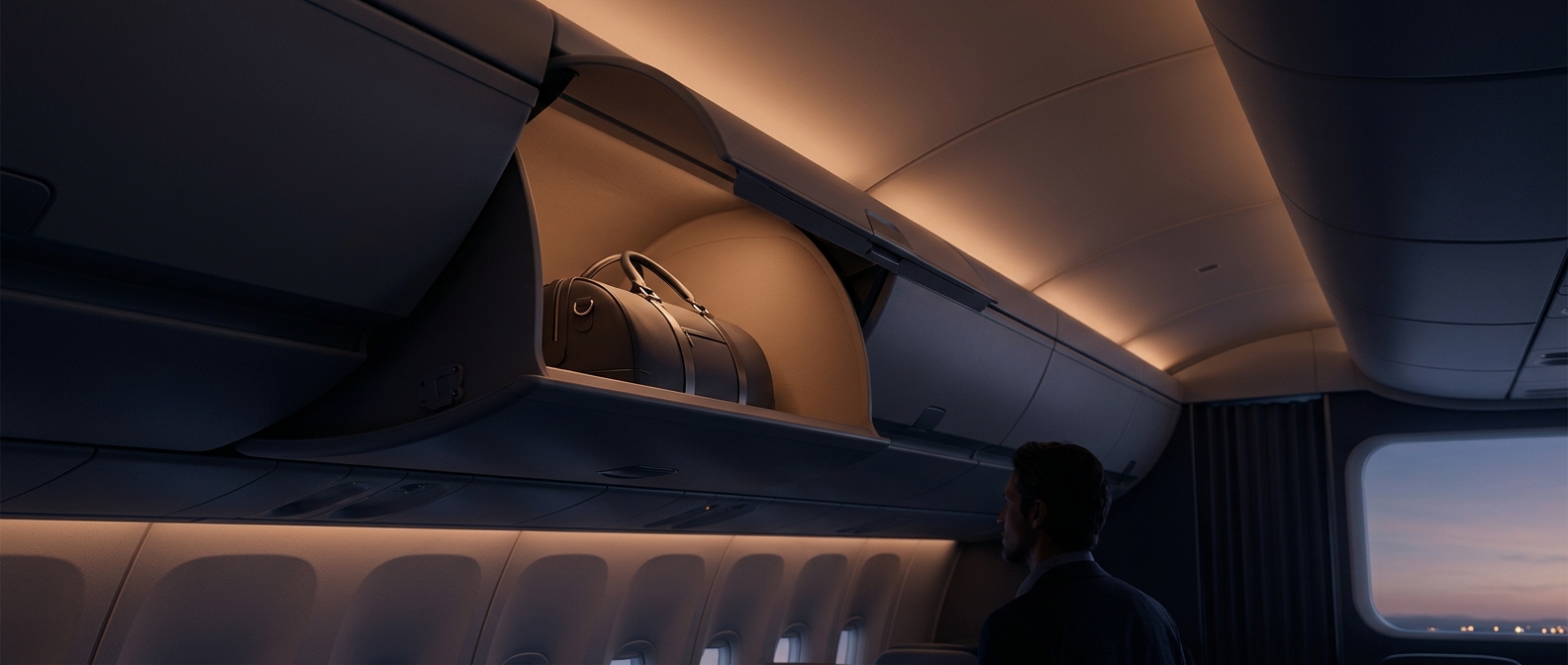
The cabin’s shape continues above the seats
An airplane cabin is not a rectangular room. Its outer shell curves inward as it rises, so the space above the seats gets narrower near the ceiling. A box-shaped bin would fit poorly there: its square upper corners would leave awkward gaps or force the bin lower, where it could intrude on passengers’ space.
A curved bin follows the available volume
The bin’s rounded interior ceiling tracks the cabin’s contour, making use of space that would otherwise be difficult to store anything in. This is a form of shape-matching: rather than treating the overhead area as a uniform box, designers fit the luggage compartment to the airplane around it.
The curve also helps preserve usable clearance below the bin. That matters in a crowded cabin, where even a small loss of headroom or aisle space affects how people move and sit. The result is a compartment that can hold bags without requiring a simple rectangular outline.
The shape influences what fits
Because the bin tapers toward the top, its capacity is not the same as a box with the same maximum width and depth. A bag that is broad or rigid near its top may be harder to place than one with a more compact profile. The overhead space is useful precisely because it follows the airplane’s curve—but that curve also shapes the limits of the luggage it can hold.