How a Hanging Weight Turns Motion Into Letters
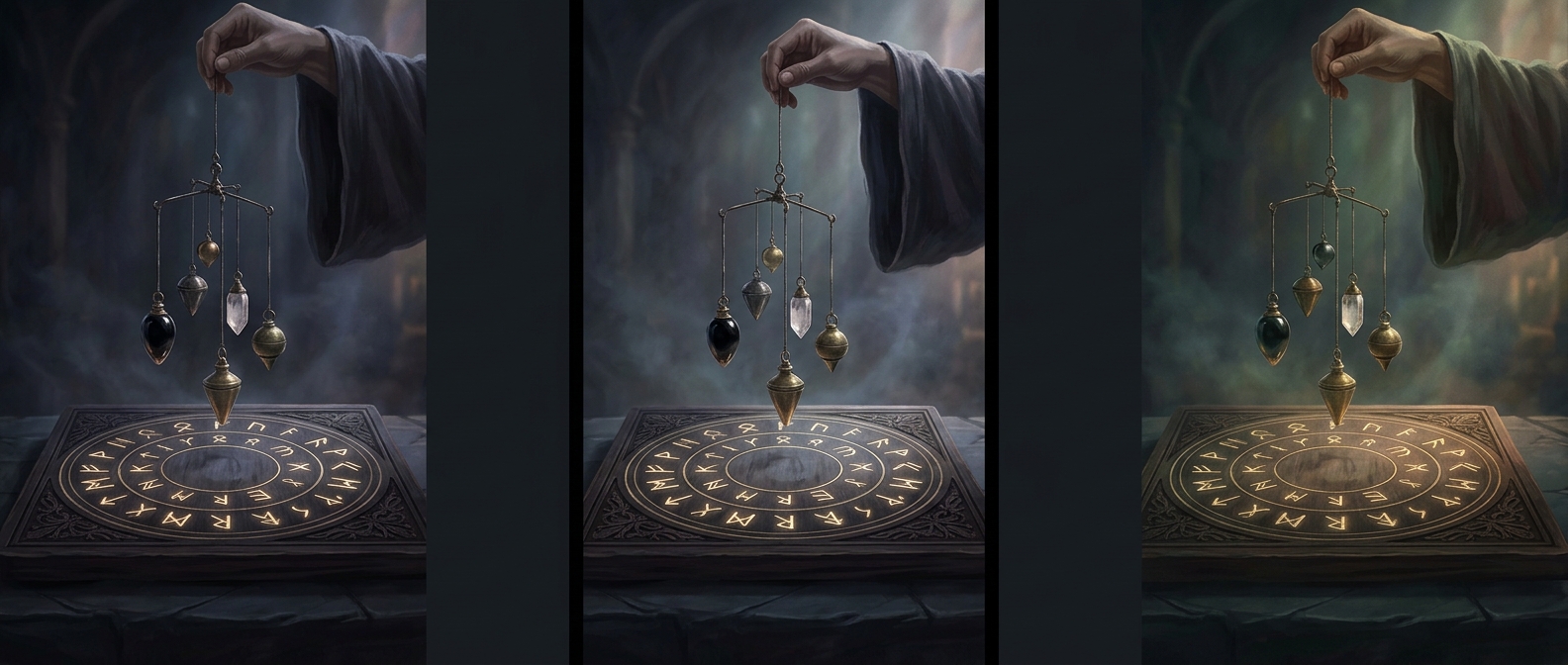
A pendulum board makes a small movement legible. A weight hangs from a thread or chain, and the person holding it keeps the support point steady while allowing the weight to swing. Because even slight shifts in the fingers can set it moving, the pendulum can trace motion that would be hard to notice in the hand itself.
The board supplies a set of possible destinations. Instead of interpreting a free-form swing, the user watches for the weight to point toward a letter, then records that letter and waits for the next one. The alphabet turns a movement into a sequence—but only if everyone involved agrees on what counts as a clear indication.
Expectation Can Shape the Swing
People can make small, unplanned movements without feeling that they deliberately chose them. This is often called the ideomotor effect: an expectation or mental image can influence tiny muscle actions, even when a person experiences the resulting motion as involuntary. With a pendulum, those motions pass through the fingers into a visible swing.
That explanation describes a way the movement can happen; it does not settle what the experience means to someone using the board. In spiritual or reflective settings, participants may treat the letters as guidance or as a way to explore thoughts that are difficult to put into words. The board’s physical setup leaves room for interpretation, especially when a swing is faint or between letters.
Why Spelling Can Take So Long
Each letter requires a separate movement and decision: wait for the weight to settle, identify its direction, note the character, and begin again. A planchette—a pointer that slides over a board—can move across letters without suspending the motion between each choice. With a dangling weight, the alphabet is both a guide and a bottleneck: it makes the message readable one character at a time, but every character must first be distinguished from the pendulum’s ordinary sway.