A magnetic field makes space into a detour
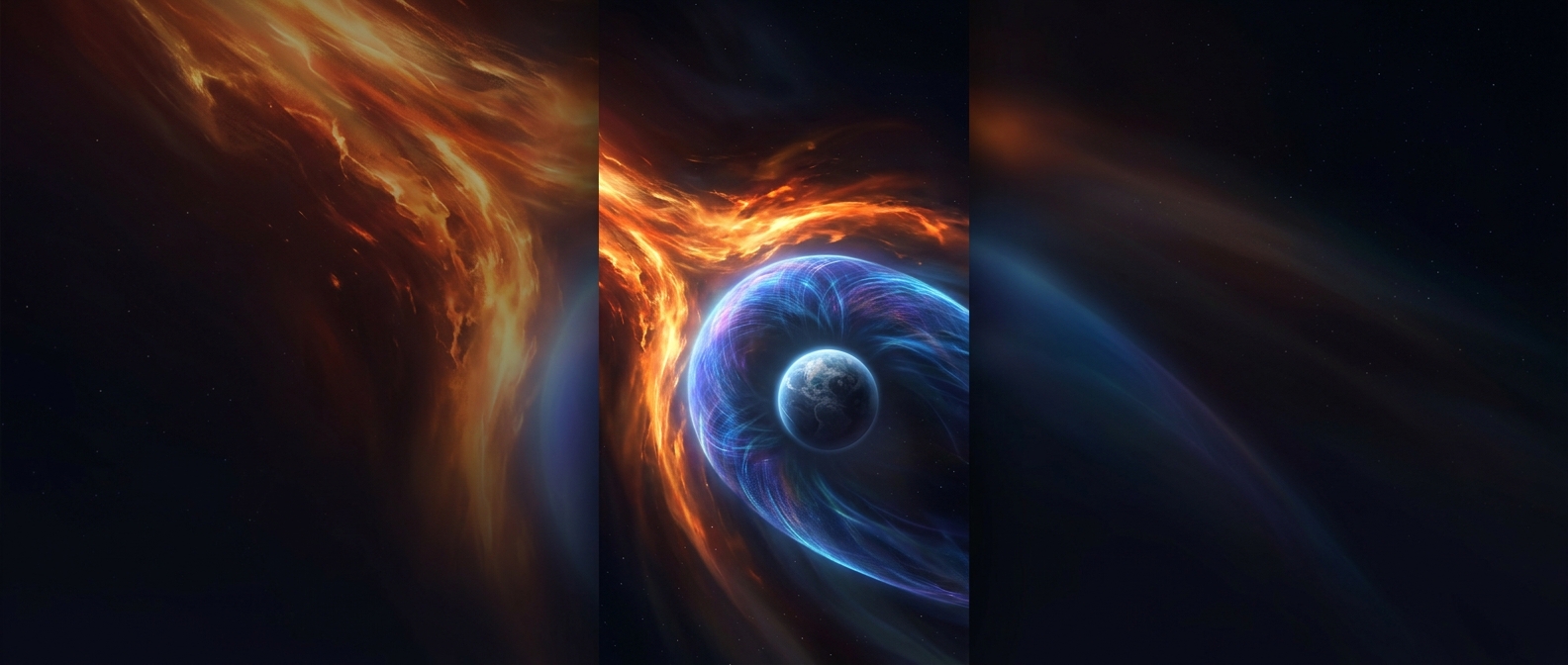
The solar wind is not a gust of ordinary air. It is a flowing mix of electrically charged particles, chiefly protons and electrons, carried outward from the Sun. Because those particles respond to magnetic forces, Earth’s magnetic field can redirect many of them before they reach the upper atmosphere.
The field’s influence extends far beyond the planet’s surface, forming a region called the magnetosphere. It is not a rigid shell: the incoming solar wind presses it inward on the Sun-facing side and stretches it into a long tail on the far side. At the outer boundary, the flow is slowed and diverted, much as traffic is routed around an obstacle rather than stopped by a wall.
Some particles find a route in
The magnetic field does not block every charged particle. Near the poles, field lines provide paths that let some particles travel downward into the upper atmosphere. There, collisions with atmospheric gases transfer energy to the gases, which release some of it as light. The resulting auroras are the visible sign of particles and energy reaching the atmosphere—not a leak through a perfectly sealed shield.
That distinction matters: Earth’s magnetic field helps limit the solar wind’s direct interaction with the atmosphere, but it is not the only protection. The atmosphere itself also absorbs and scatters harmful radiation and particles. Together, these systems make Earth’s environment less exposed than it would be without them.
Protection with a visible trace
The same magnetic field that redirects much of the solar wind also channels a fraction of it toward the poles. So the aurora is both a spectacle and evidence of the route the particles took: most were turned aside, while some delivered their energy high above the ground.