How a Space-Time Ripple Becomes a Light Signal
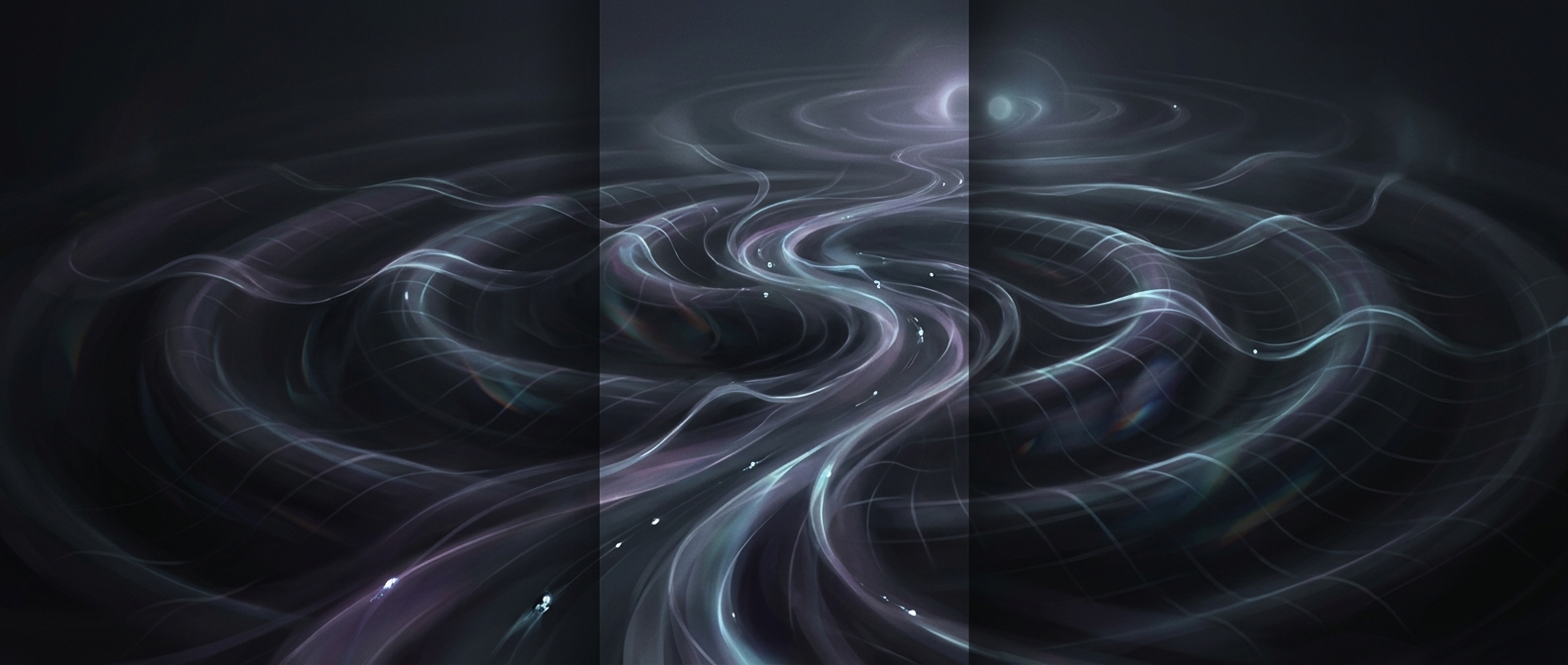
A gravitational wave is not a gust of air pushing a detector’s parts around. It is a passing change in the geometry of space itself. As the wave moves through, distances across a region alternately grow and shrink in perpendicular directions. The effect is described by strain: the fractional change in distance, which is extraordinarily small for waves reaching Earth.
The Interferometer’s Two Measuring Paths
A laser interferometer turns that change into a comparison. A beam splitter sends laser light down two long, perpendicular arms, where suspended mirrors send the light back. When the beams reunite, their light waves combine. If one round trip takes slightly longer than the other, the returning waves are out of step, changing the combined light signal.
A gravitational wave changes the relative lengths of the arms, so the timing difference shifts as the wave passes. The detector does not need to resolve each mirror’s motion as an ordinary moving object; it measures the changing relationship between the two light paths. That is how a shift vastly smaller than an atom can leave a detectable pattern in the beam.
Separating the Signal from the Noise
The same sensitivity makes the instrument vulnerable to ordinary disturbances: vibrations, temperature changes, and other sources of noise can also alter the light. Detectors therefore isolate and monitor their components, then check whether a signal has the timing and shape expected of a gravitational wave rather than a local jolt.
The practical consequence is striking: astronomers can infer a distant cosmic event from a brief change in light’s travel time, even when the wave barely alters the spacing between the detector’s mirrors.