Why a Tractor Can Turn a Highway Into a Slow Queue
A tractor is built to pull, not to cruise. Its engine and transmission are geared to deliver steady force at low speeds, so it can haul a heavy implement or work through soil without rushing. Large tires, a high center of gravity, and the equipment attached behind can make faster travel uncomfortable or unsafe. Some machines also have a road-speed limit built into their design.
That becomes a problem when fields are separated by roads. A farmer may need to move the same tractor between parcels, and driving it there can be more practical than loading it onto a trailer. The road is then serving two very different kinds of traffic: cars built for speed and a machine whose useful work depends on moving slowly and steadily.
The Risk Is in the Pass
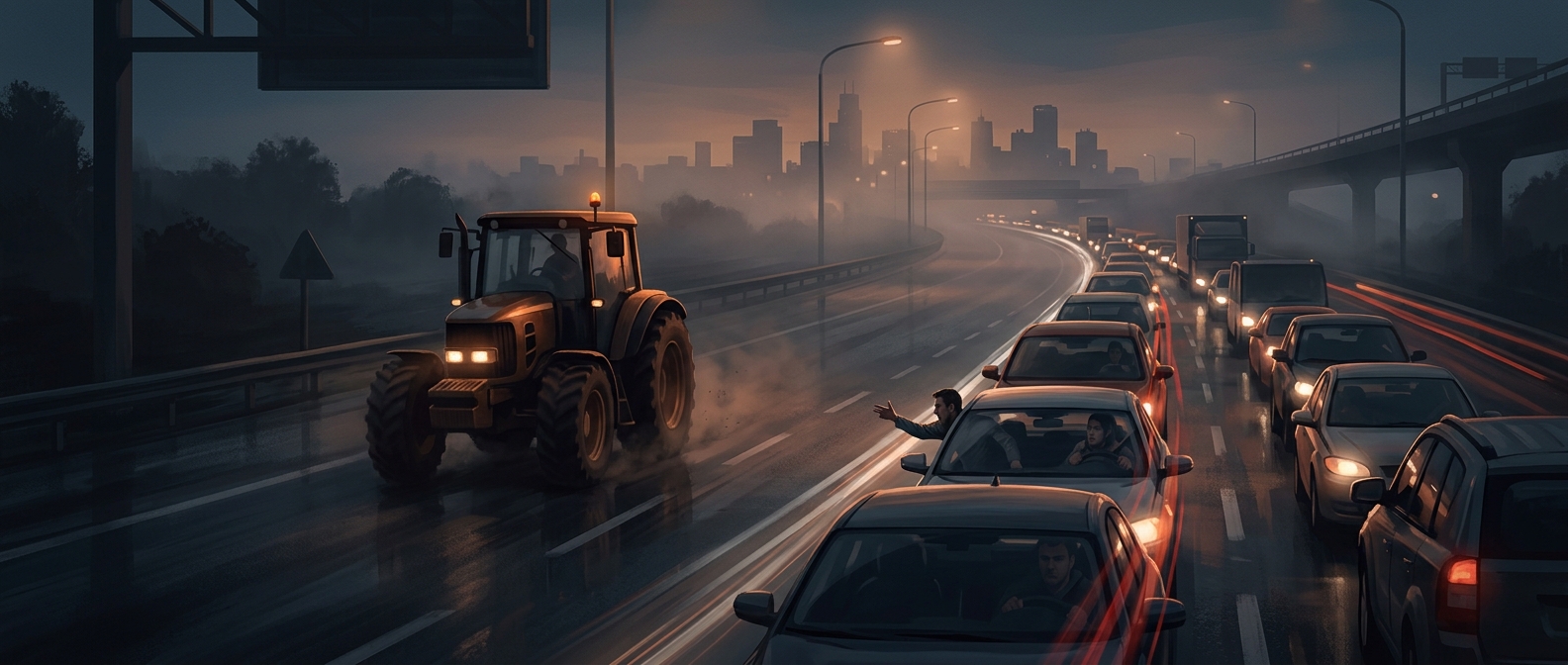
A line of cars behind a tractor can tempt drivers to overtake, but the tractor may be wide, and its trailing equipment can obscure a clear view ahead. A driver also has to judge not just the tractor’s length but how much open road is needed to pass it safely. Blind curves, hills, and oncoming traffic can turn impatience into danger.
For the tractor operator, pulling onto a shoulder is not always simple: the edge may be soft, uneven, or too narrow for the machine and its load. The safest response is often to wait for a genuinely clear passing opportunity rather than treat the slow pace as permission to squeeze by. A short farm-to-farm trip can create a long queue precisely because the road was designed around vehicles that travel at very different speeds.