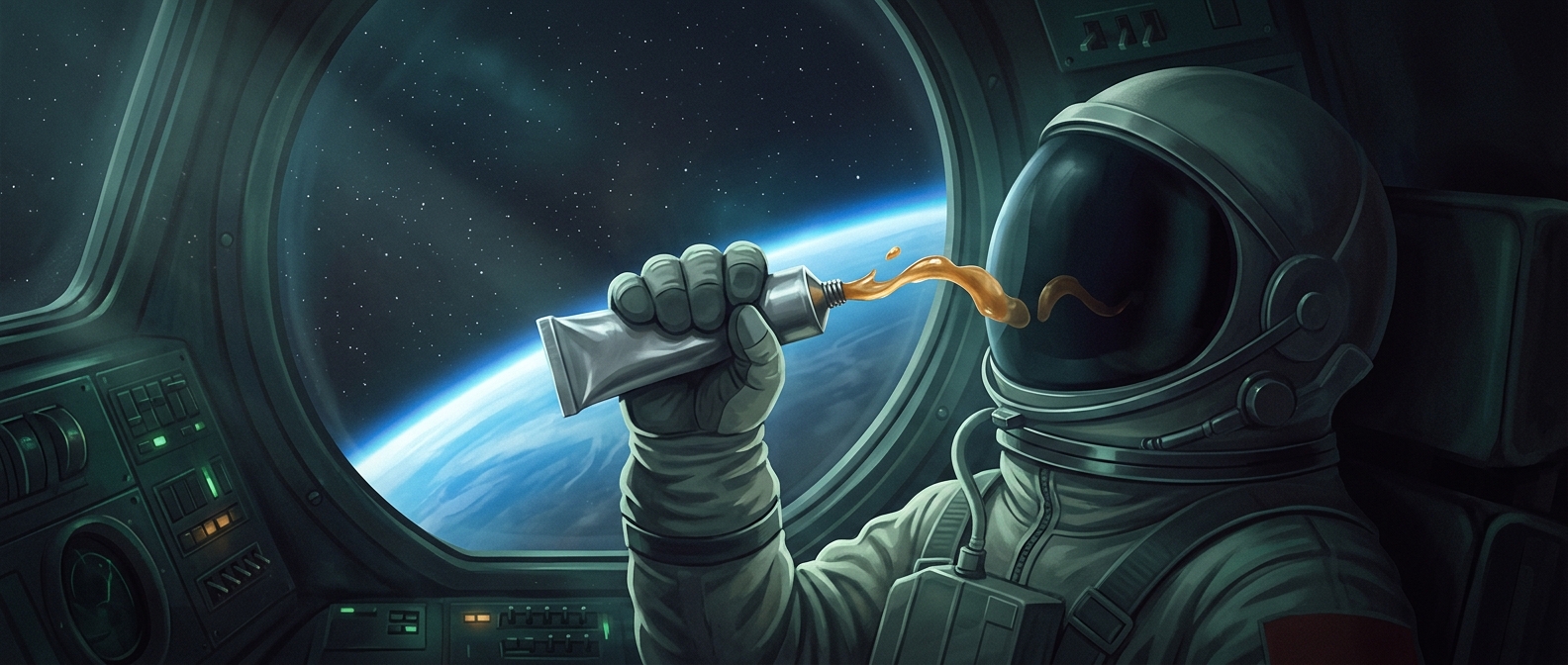
Why the first space meals came in tubes
On Earth, crumbs fall onto a tray. In weightlessness, they do not reliably fall anywhere: a loose fragment can drift through a cabin, where it might get into an astronaut’s eye or interfere with equipment. Liquids pose a similar problem, breaking into floating droplets instead of settling in a cup.
Early space food was designed around that practical hazard. Puréed beef and vegetables could be squeezed from a sealed aluminum tube, keeping the meal contained until it was eaten. The smooth texture also avoided the loose bits that made ordinary foods troublesome.
Containment came at a cost
The tube solved a packaging problem, not the problem of making lunch appealing. Its contents had to be soft enough to squeeze out, and the food emerged as a uniform paste. That made the meal look and feel more like flavored toothpaste than a familiar serving of beef or vegetables.
The tradeoff was stark: a food that was easy to contain could be hard to recognize as food. In a cramped spacecraft, where stray particles could cause trouble, that compromise made sense—even if the result was far removed from an ordinary meal.