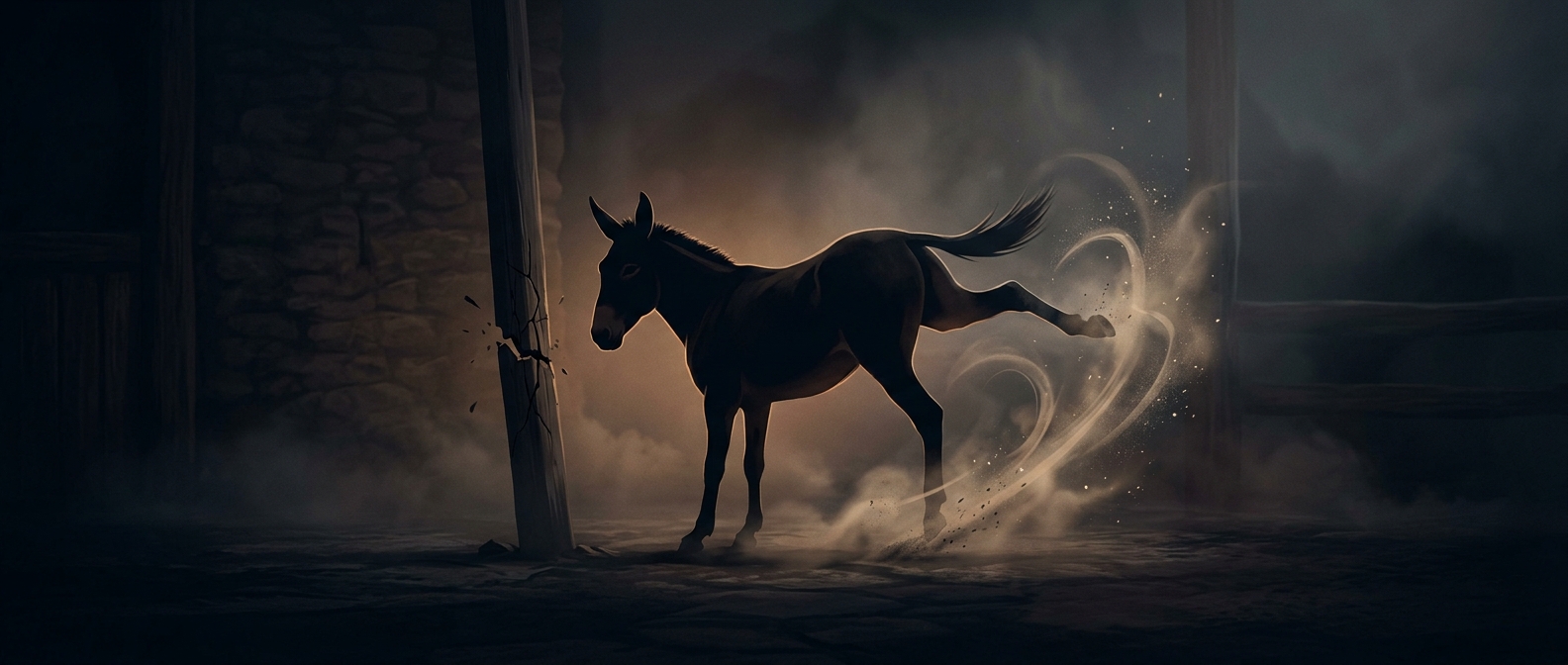
How a Mule Can Strike Beyond Its Blind Spot
A mule’s hind legs are built for more than pushing its body forward. The powerful muscles of the rump drive the legs, while the hip joints let them swing outward as well as backward. A quick shift of weight and extension of the leg can turn that movement into a forceful strike to the rear or flank.
That sideways reach matters because a mule does not have to turn its whole body to bring a hind hoof toward something beside it. The hoof can travel in an arc from the hindquarters, making the space around the animal’s back end larger—and less predictable—than a simple straight-behind approach suggests.
Why It Matters Around Working Animals
Mules have long carried people and loads over terrain where vehicles cannot easily go. But fitting a saddle or pack, leading an animal through a narrow path, or working around its legs puts a person near the hindquarters. A handler who thinks only in terms of “don’t stand directly behind” can still misjudge the reach of a lateral kick.
That is why safe handling depends on the whole animal’s position, not just the direction it faces. A mule should be approached where it can see the person, and people working around its load need to leave room for its hind legs to move. The danger zone follows the arc of the legs, not merely the line behind the mule.