How a Mosh Pit Starts to Resemble a Gas
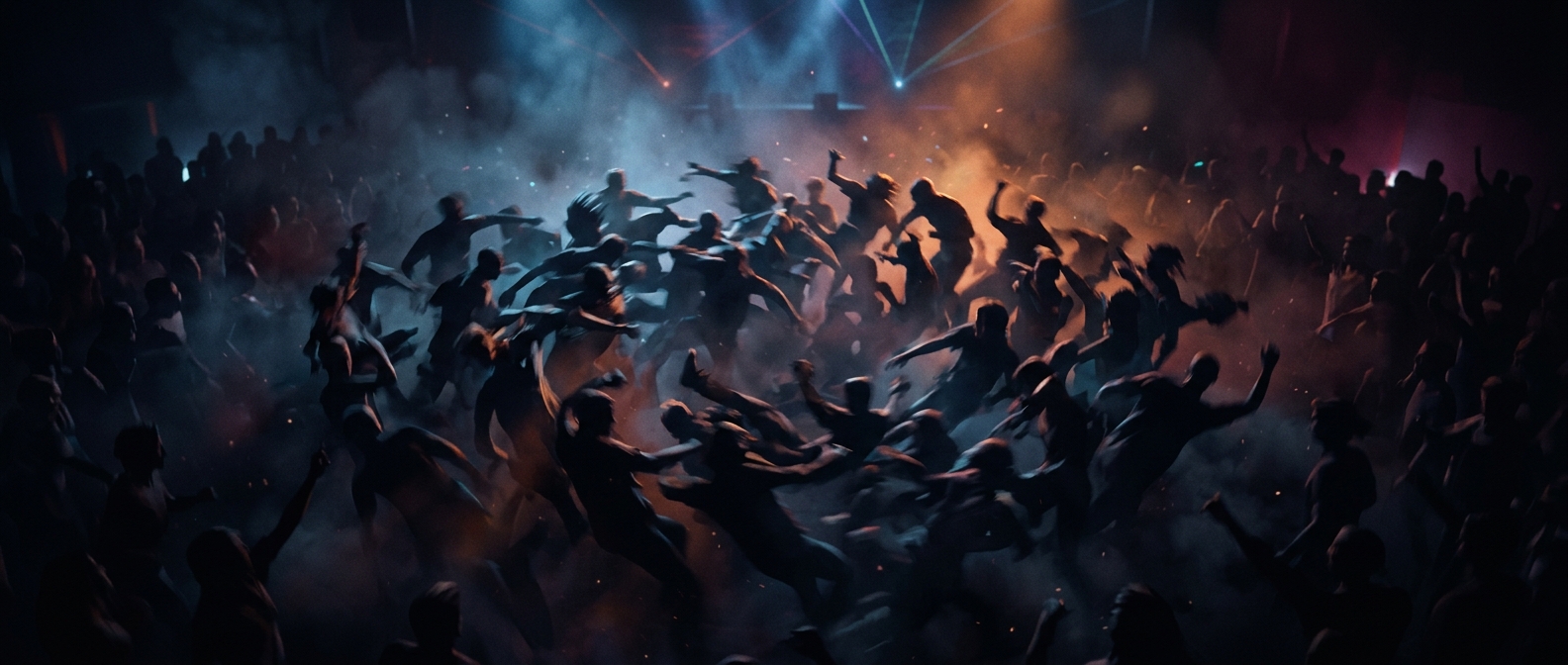
In a packed mosh pit, people surge, turn, and bump into one another without following a shared route. Each collision changes someone’s direction, and that person may then set off another collision. When the motion becomes sufficiently crowded and unpredictable, the crowd’s overall movement can look less like a coordinated dance and more like particles jostling inside a container.
The comparison is about the pattern, not the people. Gas molecules move randomly and collide; moshing concertgoers move under their own power and can notice, anticipate, or respond to others. Still, at the scale of the whole pit, individual paths can become hard to predict while the crowd remains confined by the people and space around it.
What the “Container” Changes
A pit’s boundaries help shape its motion. People at the edge may be pressed toward the center, while those moving outward meet other bodies or the surrounding crowd and are redirected. In that way, the room and the crowd itself limit how far a person can travel, much as a container limits the movement of gas particles.
The analogy helps explain why a pit can feel chaotic even when no one is steering the crowd as a whole: simple, repeated collisions can produce disorderly group motion. But it does not mean a mosh pit follows the exact laws of a gas. People can choose to slow down, make space, or help someone who falls—responses no gas particle can make. That human difference is also what can turn a shifting mass of bodies back into a crowd looking out for one another.