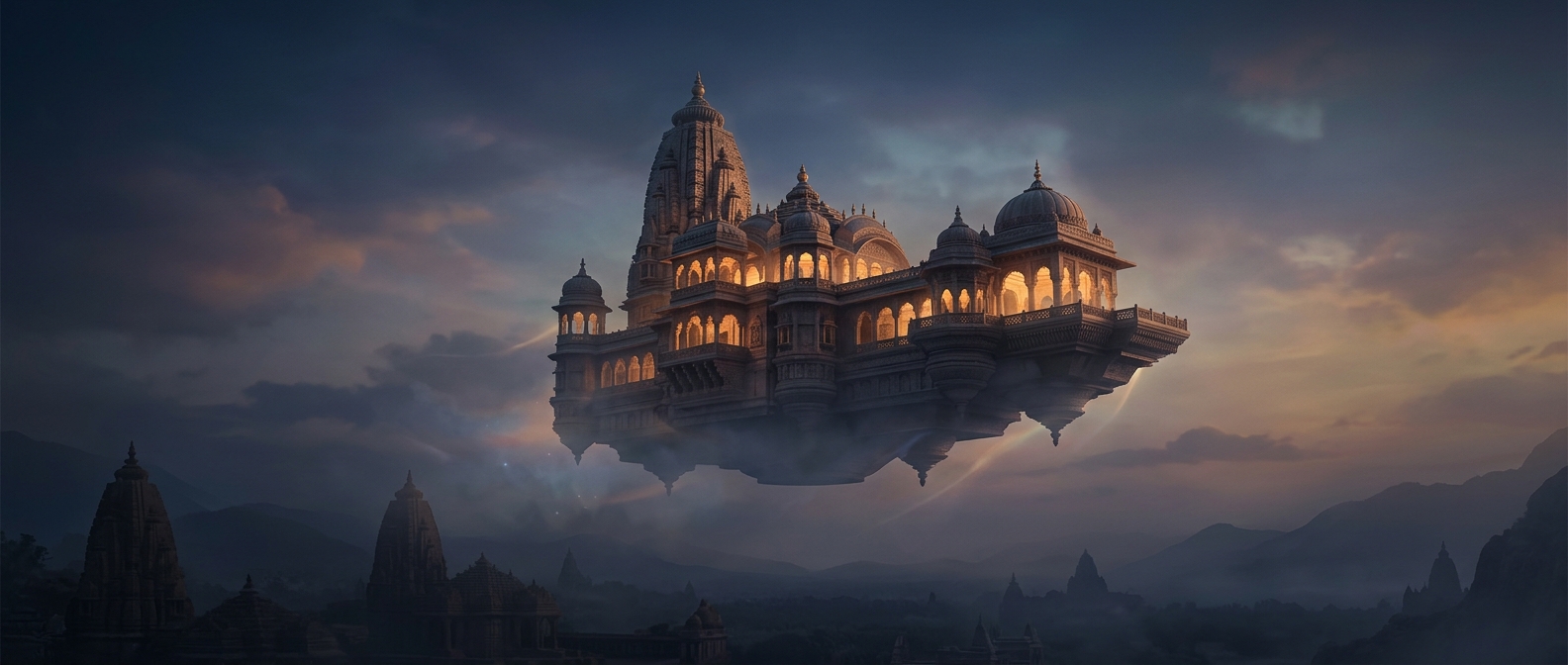
A flying palace in the epic imagination
In Hindu epic literature, a vimana can be more than a vehicle: it may be a palace carried through the sky. The image joins two kinds of grandeur—royal architecture and supernatural mobility—so a ruler’s home, court, and means of travel can become one extraordinary object.
One famous example appears in the Ramayana: Pushpaka, a wondrous aerial vehicle associated with the wealth and power of Lanka’s king Ravana. After Rama defeats Ravana, the story has Rama and his companions travel back to Ayodhya aboard it. The vehicle’s role is therefore not merely decorative; it helps carry the epic from a battle’s aftermath toward the restoration of a kingdom.
What the image conveys
A palace normally signals settled authority: it is where a ruler receives visitors, displays wealth, and governs. Making that palace fly overturns those expectations. It suggests power that can move beyond ordinary borders and carries the royal world itself wherever its owner goes. The scale of the image also makes the vehicle feel less like a practical machine than a wonder suited to epic events.
Descriptions of vimanas vary across texts and traditions, and the term does not always refer to the same kind of craft. In these stories, flight belongs to a mythic world where extraordinary beings and objects are part of the narrative. The image’s lasting force lies in that combination: a flying vimana turns royal power into something that can take its entire palace with it.