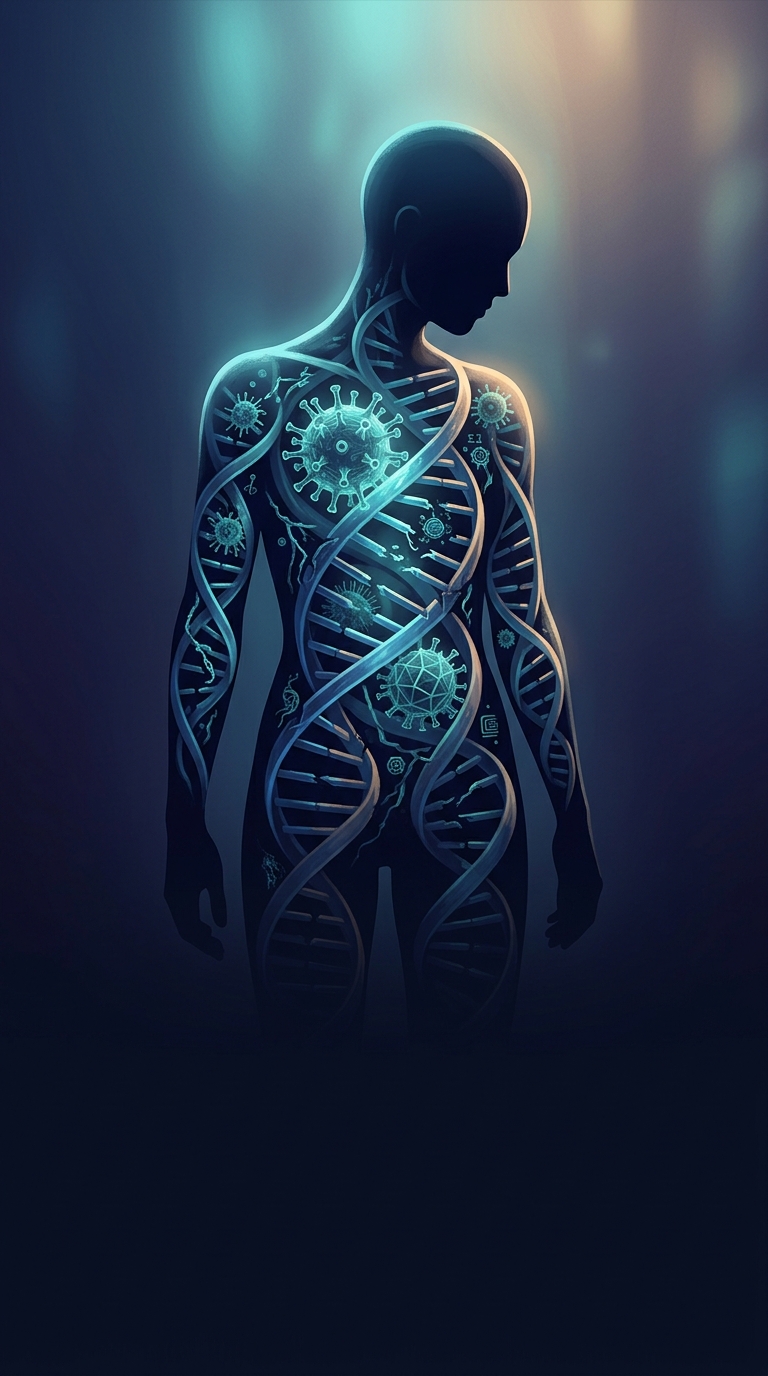
Roughly 8% of human DNA is viral in origin
About 8% of the human genome consists of remnants of ancient retroviruses—viruses whose genetic material can be copied into DNA and inserted into a cell’s chromosomes. That is a larger share than the roughly 1–2% of our DNA that directly encodes proteins.
These remnants are not intact viruses hiding in our genes. Most are broken, rearranged, or missing the instructions needed to make a virus.
How viral DNA became inherited
A retrovirus normally inserts its DNA into an infected cell. If that happens in a cell that contributes to an egg or sperm, the inserted sequence can pass to offspring. Over many generations, descendants inherit the sequence as part of their own genome.
Mutations gradually erode the viral instructions. Repeated copying and reshuffling of DNA can break them further, leaving scattered fragments. Scientists call these inherited sequences endogenous retroviruses: “endogenous” means originating within the organism. The estimate counts these remnants, not active infections or complete viral genomes.
Some remnants found a new role
Most viral fragments appear to have no useful function, but a few have been recruited by evolution for jobs in the body. One well-known example is a gene derived from an ancient retrovirus that helps cells fuse to form the placenta’s outer layer. A viral tool for merging with cells became useful in mammalian reproduction.
So the striking figure does not mean humans are one-twelfth virus. It means our evolutionary history left a substantial archive of viral DNA—and, in a few cases, evolution put parts of that archive to work.