A bridge officer, not a background figure
When Star Trek debuted in 1966, Nichelle Nichols’s Lieutenant Nyota Uhura occupied an unusual place on American television: she was a Black woman serving as a communications officer on the bridge of a starship, among the crew members responsible for its operations. The role did not make her the series’ lead, and the show still reflected the limits of its era. But Uhura was not written as a servant or a comic stereotype. She was a competent professional whose presence in the command center was treated as ordinary.
That distinction mattered in a medium where Black characters were often given narrower, less authoritative parts. Television brought its images into viewers’ homes week after week, making a future in which a Black woman held a respected position visible to a broad audience.
Why Nichols reconsidered leaving
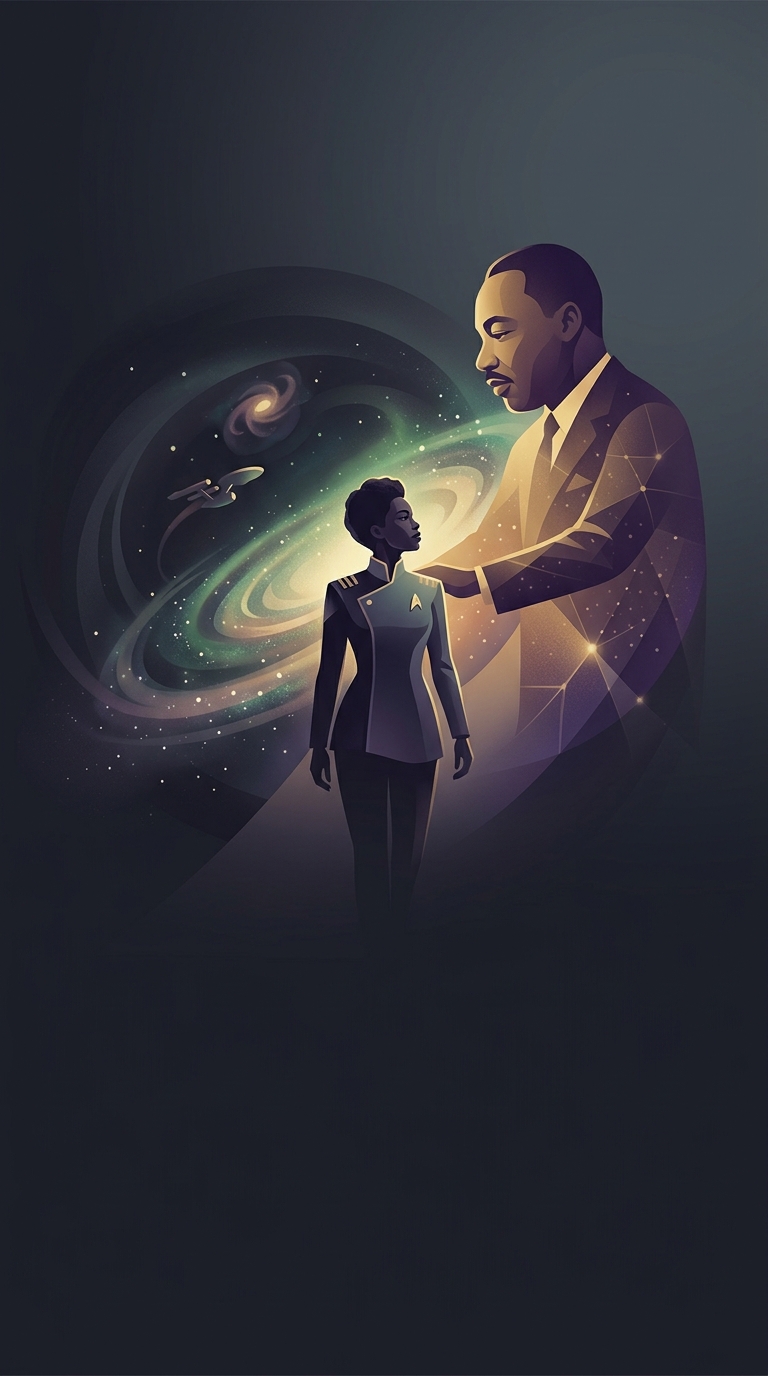
After the first season, Nichols was considering leaving the series. At an NAACP event, she met Dr. Martin Luther King Jr., who urged her to stay. Nichols later recounted that King admired the role and told her that her portrayal mattered—not only as an acting opportunity, but as an image of Black possibility on television.
The force of that appeal lay in what Uhura represented without needing a speech about civil rights: she belonged on the bridge. In a science-fiction setting, the show could place a Black woman in a future society that did not treat her authority as something requiring explanation. Viewers could encounter that image as part of an adventure, rather than as an abstract argument.
A fictional future with real-world reach
Nichols’s decision to remain gave the role time to become part of the series’ lasting cultural footprint. The show’s futuristic setting did not erase the barriers of 1960s America, but it offered a memorable counter-image to them. The bridge’s mix of crew members also made cooperation across racial lines part of the story’s everyday visual language.
That is the consequential intersection: a modest television role could carry an idea far beyond its plot. For viewers, Uhura was not merely someone transmitting messages across space; she was a Black woman already seated where the decisions were made.