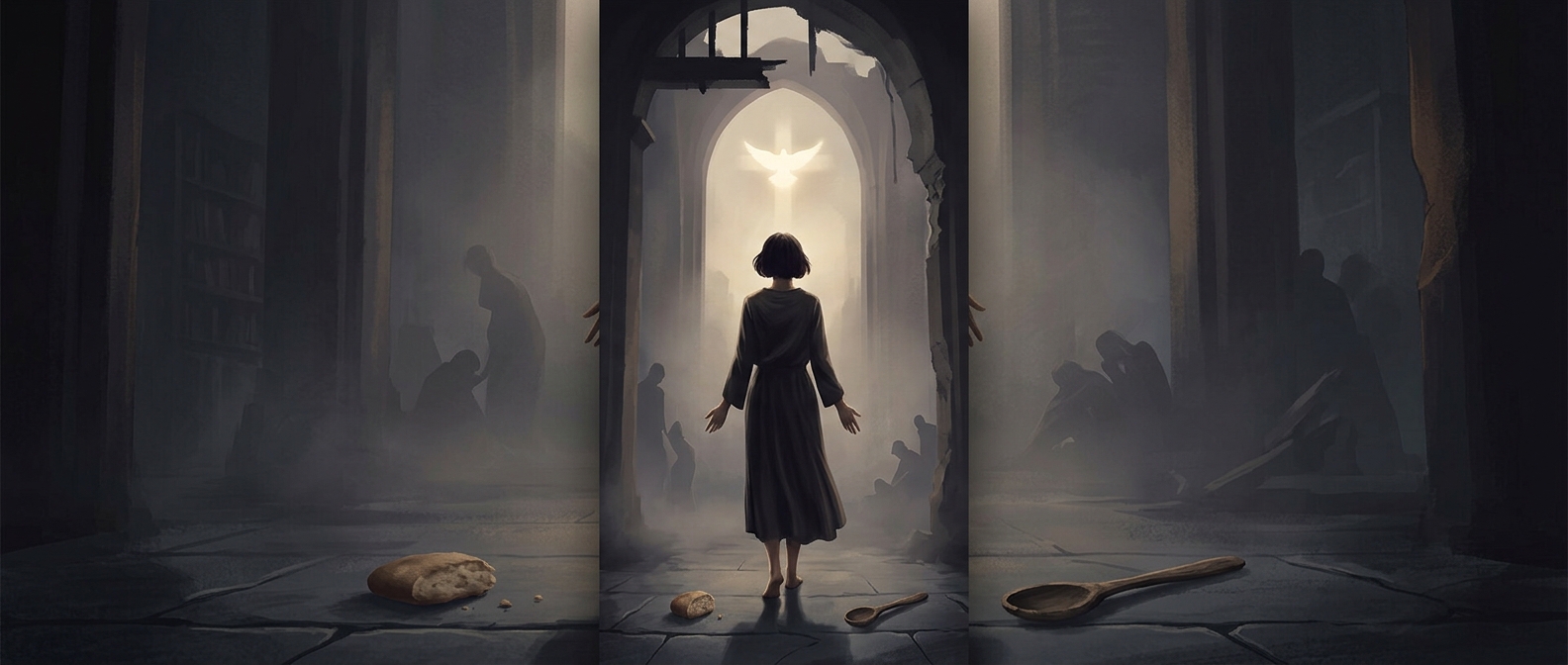
A wafer with spiritual, not ordinary, nourishment
Accounts of Catherine of Siena describe a striking pattern: she fasted so severely that she reportedly could no longer swallow ordinary food, taking only the thin wafer received in Communion. In Catholic practice, that wafer is the consecrated bread of the Eucharist, the central sacrament of the Mass. Its importance is religious; it is not a meal capable of supplying the energy and nutrients of ordinary food.
That distinction helps explain why the detail mattered to the people who told her story. The wafer was not simply the one food she could manage. It represented a sacred form of sustenance, making her dependence on Communion a sign of devotion in the accounts of her life.
When fasting became a bodily limit
Catherine lived in the 14th century, when intense fasting could be understood as a form of religious discipline: a way to express penitence, self-control, and closeness to God. But the story also describes a physical consequence. After prolonged restriction, ordinary eating was no longer possible for her, according to the accounts.
The reports do not give enough information to reconstruct exactly what she ate or how her condition developed. What they preserve is the tension at the heart of the episode: a practice understood in spiritual terms had reached the point where the body could not readily return to everyday nourishment. That is why the wafer became more than a detail about her diet—it marked the boundary between religious devotion and the body's basic need for food.