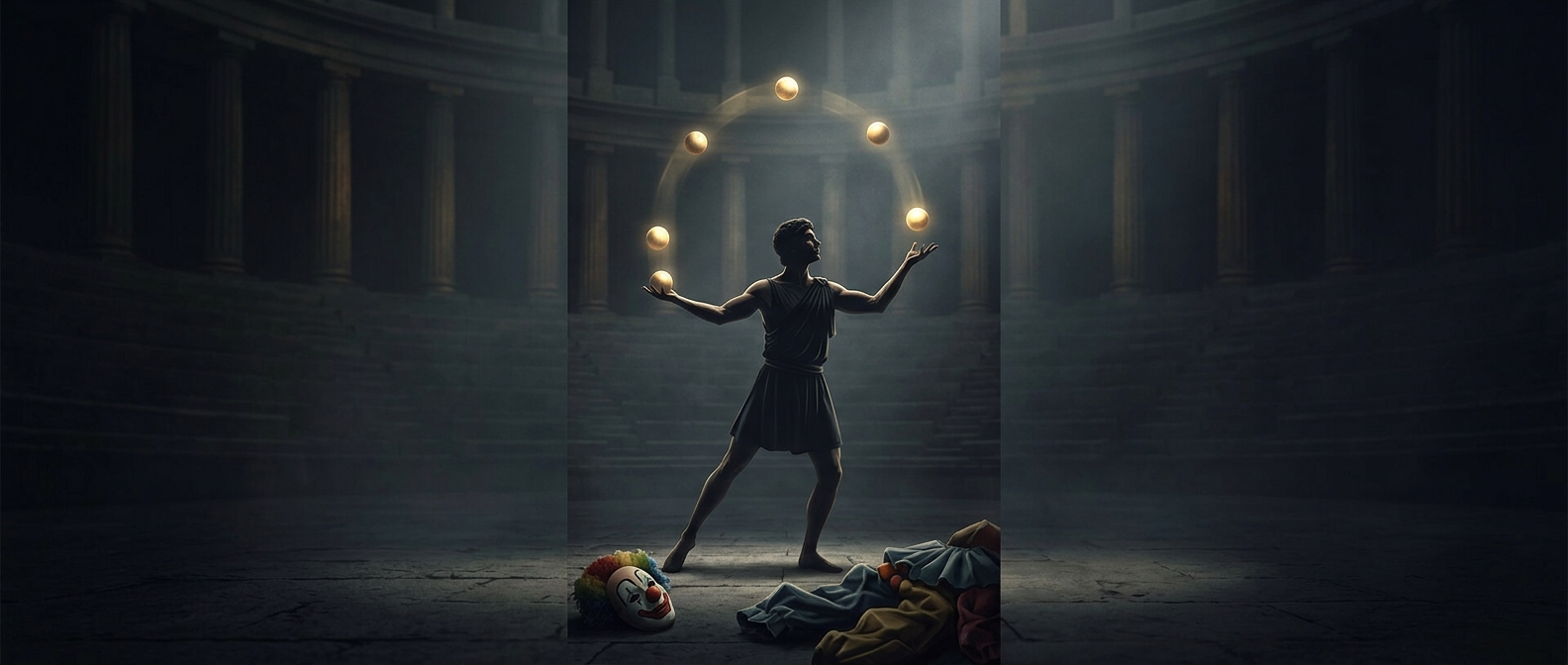
Juggling Put Athletic Skill on Display
Juggling can look effortless when performed well, but it depends on a demanding loop of prediction and correction. A juggler must track several objects moving along different arcs, release each at the right moment, and move a hand into place before the next catch. Speed, accuracy, rhythm, and sustained concentration all matter; a small timing error can unravel the pattern.
That made juggling suited to competition as well as spectacle. When people treated it as an athletic discipline, the point was not simply to amuse an audience with a surprising trick. It was to demonstrate control under pressure—a physical skill that could be practiced, compared, and admired, much like other feats of coordination and dexterity.
The Performer Was the Point
Modern audiences often associate juggling with clowns or party tricks, but those settings can obscure the work behind the performance. A successful routine depends on repetition: the performer learns how objects travel, builds reliable timing, and gradually attempts patterns that leave less room for correction. The visible flourish is the result; the discipline is the trained control that makes it possible.
Seeing juggling this way changes the meaning of the spectacle. The objects are not merely props: they make the performer’s timing and precision visible to everyone watching. A catch is the proof of a decision made a fraction of a second earlier.