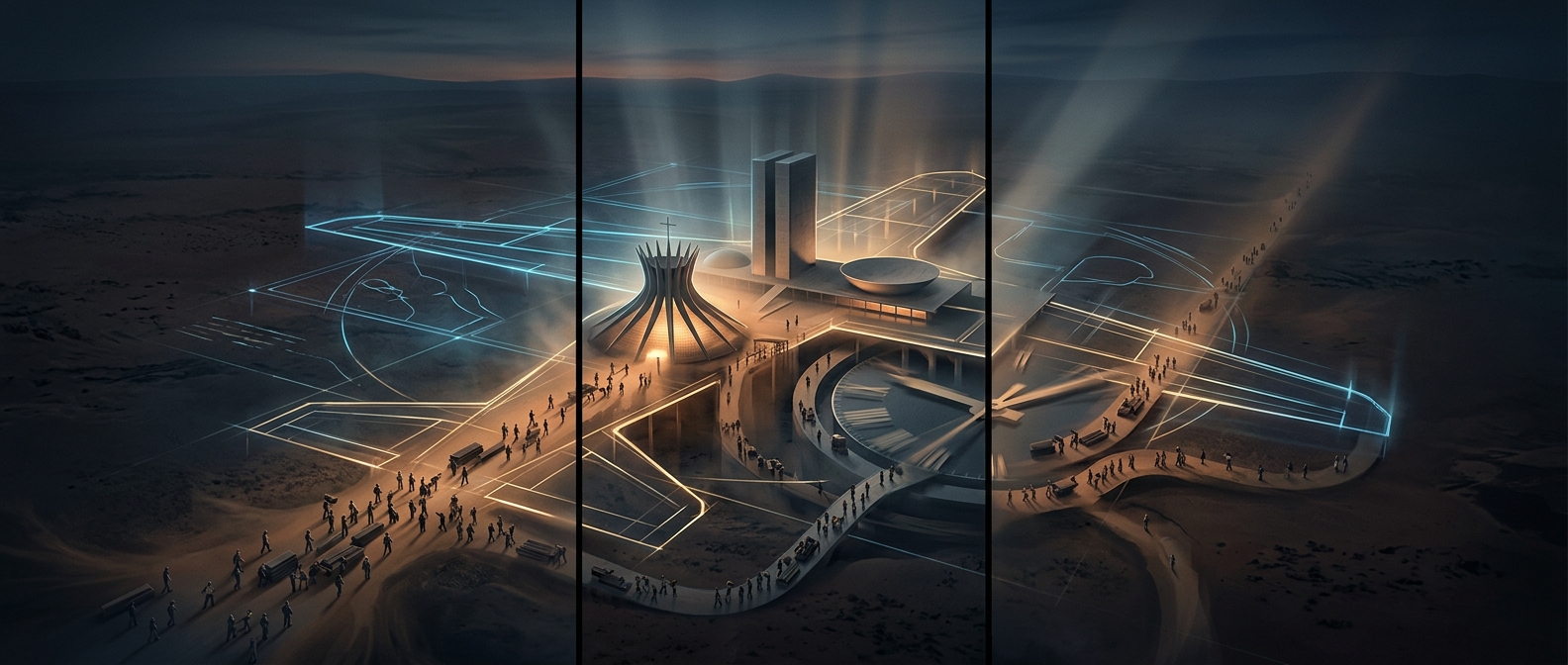
A capital designed to move Brazil’s center of gravity
Brasília’s 41-month construction was not simply a race to erect buildings. It was an effort to make a political idea visible: Brazil’s capital should stand in the country’s interior, not on the Atlantic coast. Moving the seat of government inland was intended to draw attention, investment, and transport links toward a region far from the established coastal centers.
President Juscelino Kubitschek made the new capital a priority after taking office in 1956. The deadline gave the project unusual force: roads, public buildings, housing, and the machinery of government had to take shape together, so the city could function when the capital officially moved in 1960.
A city planned before it filled in
Brasília was laid out as a designed whole rather than allowed to grow street by street. Urban planner Lúcio Costa’s plan organized the city around broad avenues and distinct areas for different activities. Architect Oscar Niemeyer designed many of its most prominent government buildings, giving the new capital a recognizable modernist skyline.
That division of labor helped turn an immense project into connected tasks: plan the layout, build the main structures and infrastructure, and prepare the institutions that would occupy them. It also meant that Brasília’s first form reflected the decisions of its planners more than the gradual choices of generations of residents.
The human cost of the deadline
The construction depended on large numbers of workers who came from other parts of Brazil, especially the northeast. Often called candangos, these workers built the city under demanding conditions. The capital’s rapid completion therefore had two sides: the state gained a functioning seat of government on schedule, while the people who made that speed possible did not automatically share in the prominence or comfort of the planned center.
When the government moved in, Brasília was more than a set of striking buildings. It was a working national project—and a lasting demonstration that a government could shape where a country’s political center stood.