From atmospheric showers to volcanic probes
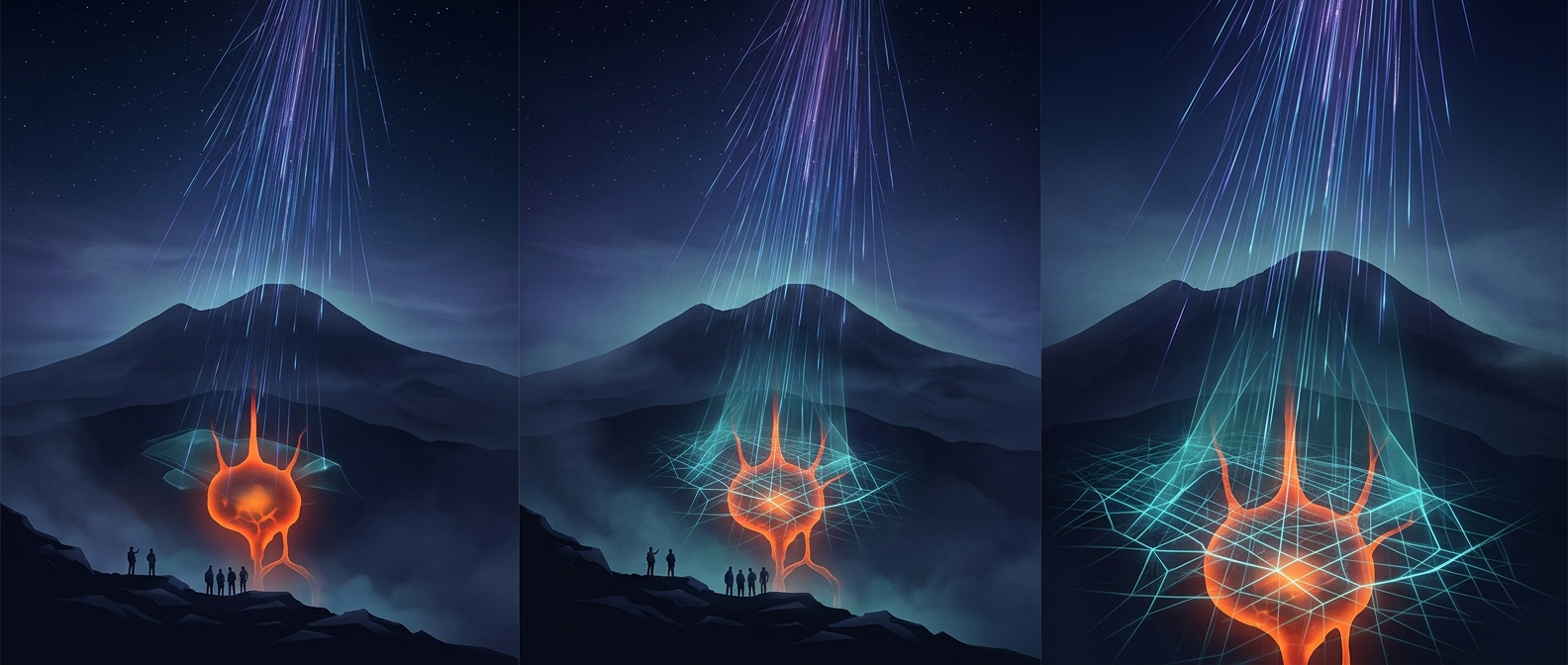
Cosmic rays are high-energy particles arriving from space. When they strike atoms high in Earth’s atmosphere, they trigger cascades of secondary particles, including muons—heavy relatives of electrons that can travel through substantial amounts of rock before being stopped or deflected.
That persistence makes muons useful for imaging a volcano. A detector records the direction each muon came from, then compares how many arrive through the mountain with how many arrive along an unobstructed path. A thick, dense section is more likely to block muons, so it casts a stronger “shadow” in the measurements.
Turning shadows into a map
Each detector view is a set of measurements along many paths, not a photograph of the interior. Researchers combine counts from different directions—and, when possible, different detector locations—to infer how density varies inside the volcano. The method is called muography, analogous to X-ray imaging but using naturally produced particles that arrive from above.
The geometry matters: a detector must have a clear view of the part of the volcano being studied, and collecting enough muons can take time. The result also reflects density, not a direct label of what a region contains. Dense rock, compacted material, and other structures may affect the signal in similar ways, so the map is interpreted alongside other evidence.
What the shadow can reveal
A denser or more open region can help scientists identify internal structures, such as solid rock versus cavities or lower-density zones. Repeating observations can also show whether the density pattern changes, offering a way to watch a hidden mountain without drilling into it.
The striking consequence is practical: a volcano can be probed by particles that were made in the atmosphere, with the mountain itself supplying the contrast that turns their missing paths into an image.