How Io turns orbital motion into heat
Io’s volcanoes are powered not by sunlight or a hot interior left over from its formation, but by energy continually added as it moves around Jupiter. The key is that Io’s orbit is slightly oval rather than perfectly circular. Its distance from Jupiter therefore changes during each orbit, and Jupiter’s pull changes with it.
That changing pull raises and lowers enormous tides in Io’s solid body. The moon is not merely lifted at its surface: it flexes through its interior. Rock resists that deformation, and friction converts some of the orbital energy into heat, much as repeatedly bending a sturdy object can warm it. Io’s orbit stays oval partly because gravitational tugs from neighboring moons keep disturbing it, so the heating does not simply stop once the moon has been stretched.
A surface that is continually remade
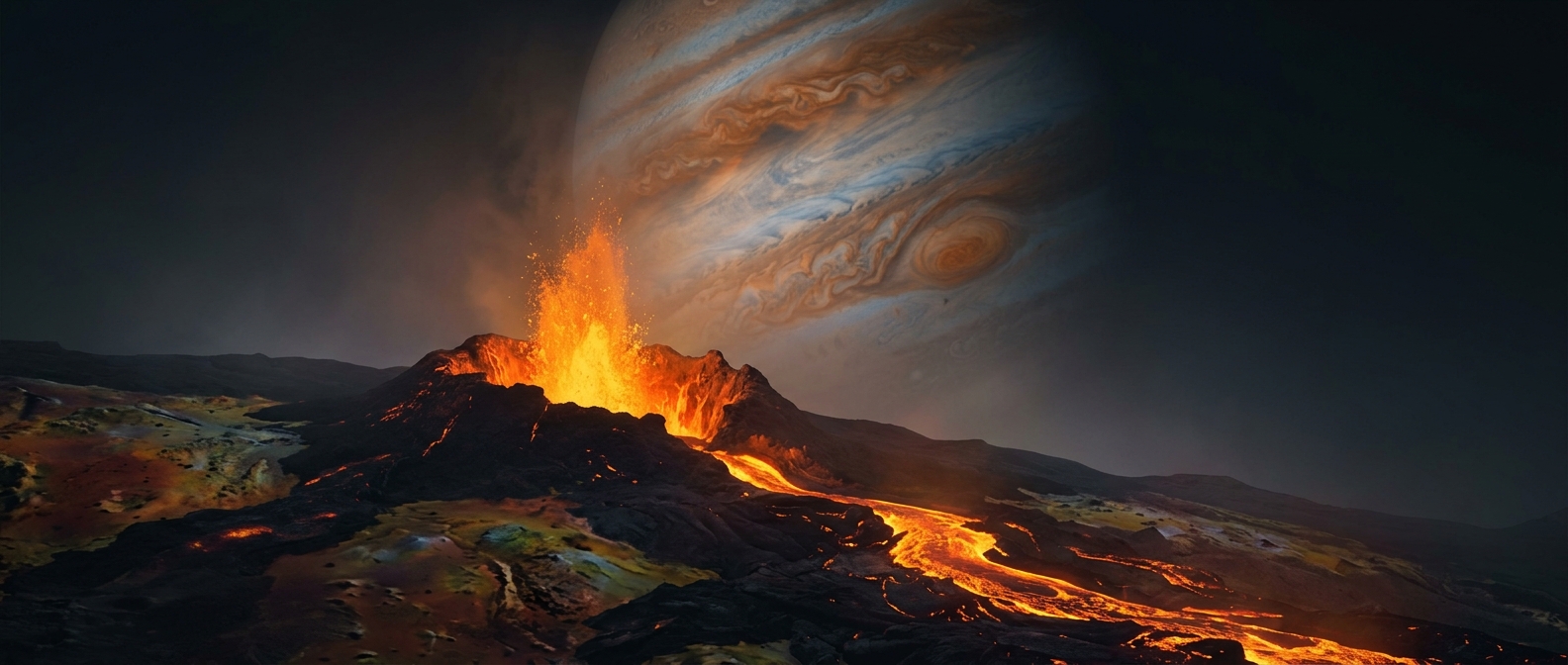
The heat melts rock beneath the surface, allowing magma to rise through cracks and erupt. Some eruptions throw material high above the ground; sulfur-bearing gases and compounds can spread outward and settle as colorful deposits. In Io’s thin, airless environment, these materials do not weather away as they would on Earth. Meanwhile, fresh lava buries older terrain.
The result is a world whose landscape is unusually young-looking: impact craters are scarce because eruptions repeatedly erase or cover them. Io’s volcanoes are a visible outlet for energy supplied by its orbit, linking the motions of Jupiter’s moons to changes on a moon’s ground.