A crater can turn a sideways impact upward
A falling drop does not simply flatten when it hits water or another wet surface. Its momentum pushes the surface down and outward, opening a shallow crater. Around the crater, the displaced liquid forms a rim and begins to move back inward under the pull of gravity and surface tension—the tendency of water to minimize its exposed area.
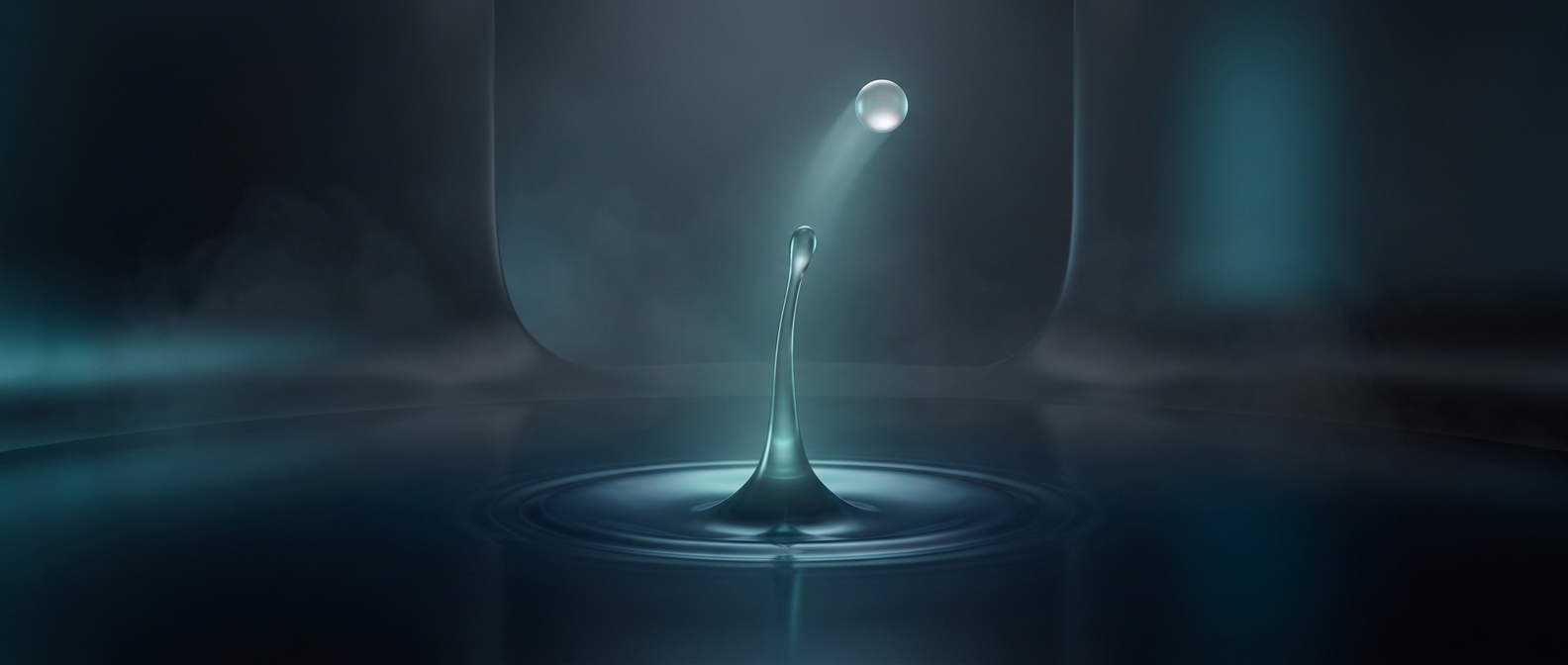
As the crater closes, liquid from different directions converges. That motion can squeeze some of the water upward into a narrow jet, much as converging flows can force liquid through a small opening. The jet is a Worthington jet, named for the physicist who studied splashes. It is not a rigid spike: it is a fast-moving column of liquid that may thin and break apart.
Why the jet becomes droplets
The column can stretch and narrow until surface tension can no longer hold it together. It then pinches into separate droplets. Their size and number depend on the impact and the surfaces involved: a deeper cavity, a faster collision, or a different surface texture can change how the liquid moves and whether a jet forms at all.
The upward direction is the surprising part. The original drop’s motion is downward, but the crater’s collapse gathers that motion inward and redirects part of it vertically. If the surface carries dust, microbes, or other loose material, some may be swept into the liquid and travel with droplets that leave the surface—turning a brief splash into a way for material to become airborne.