Why Blindman’s Bluff Worked at Court
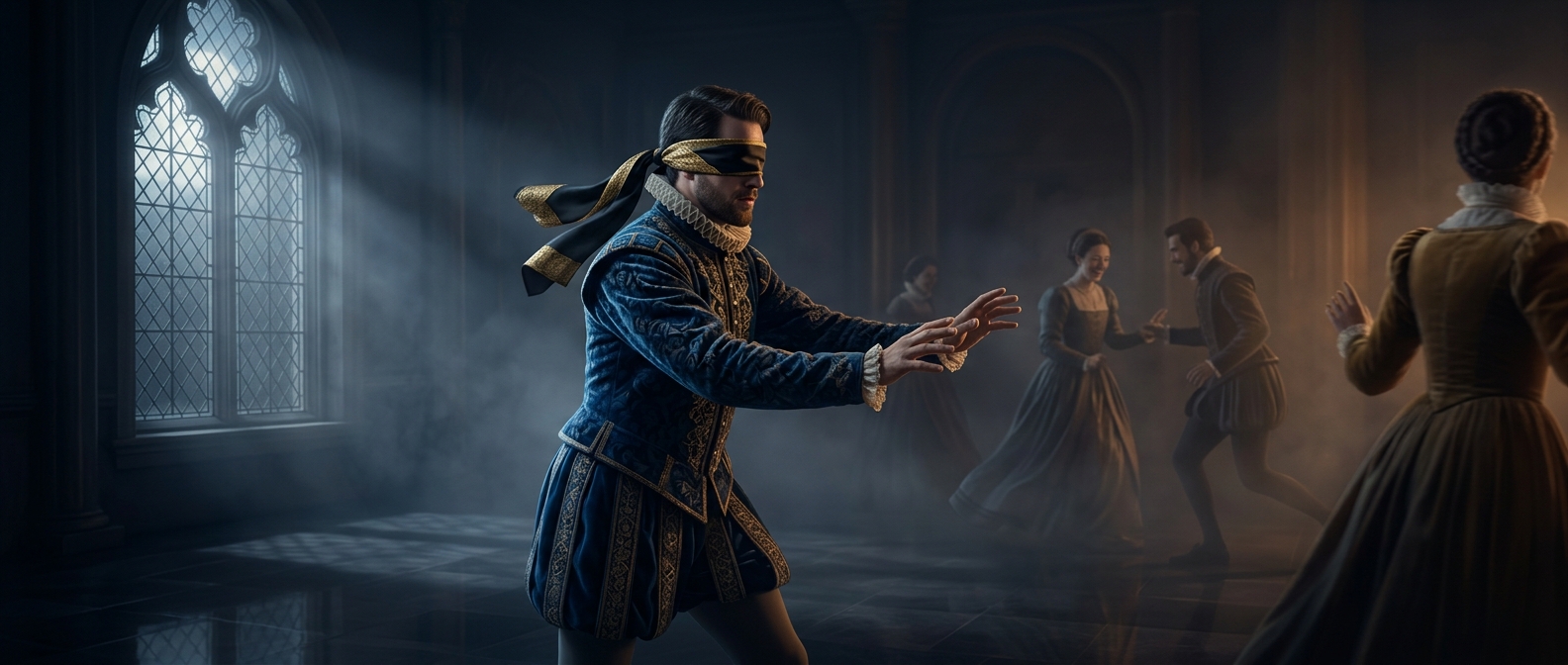
Blindman’s bluff turns an ordinary room into a game of incomplete information. One player is blindfolded and tries to catch the others, who dodge by listening and moving carefully. The blindfolded player loses sight, but not hearing or touch, so every shuffle or laugh can become a clue—and a misjudgment can send someone stumbling in the wrong direction.
That simple setup made the game entertaining to watch as well as play. A hall usually associated with ceremony and orderly movement could become a space of evasions, near misses, and sudden catches. The contrast supplied much of the fun: players had to navigate a familiar room while temporarily unable to see it, and onlookers could follow the chase from the outside.
A Game of Changing Roles
The blindfold also briefly rearranged the social scene. Whoever wore it had to rely on sound and the others’ movements; those avoiding capture controlled how much they revealed. Then the roles could switch. The game’s appeal did not depend on elaborate equipment or complicated rules, but on the tension between what the seeker could detect and what the others could conceal.
In a Tudor court, that made a children’s-style chase adaptable to aristocratic company: the spectacle came from seeing courtly surroundings—and their occupants—caught up in a game of misdirection.