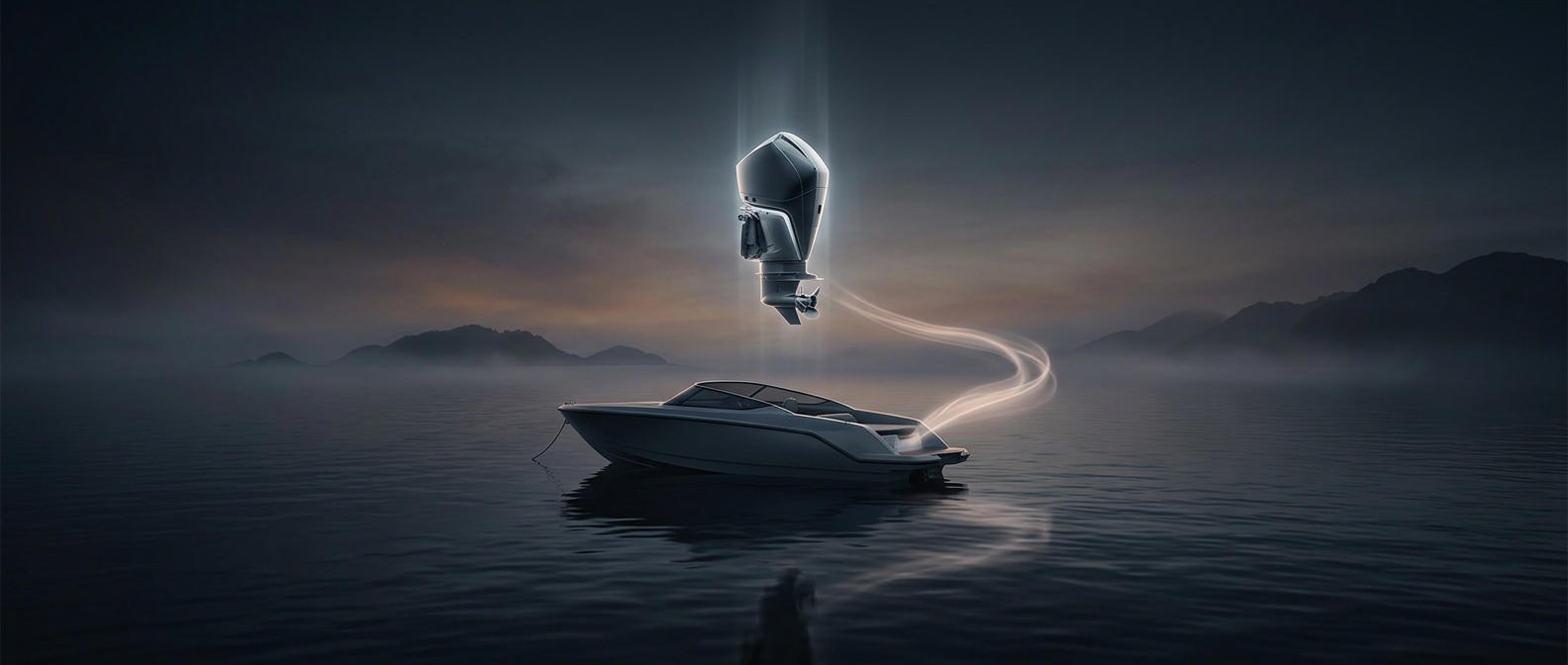
Why Put the Powerplant on the Stern?
An outboard keeps its engine outside the hull, leaving the boat’s interior free of a large engine compartment and the shaft that would otherwise run through the hull to a separate propeller. Power travels down through the motor’s leg to a gearbox near the water. There, gears redirect the engine’s rotation to drive the propeller. The submerged lower section also helps direct the flow of water that pushes the boat forward.
Because the propeller is attached to the motor, steering can happen at the source of thrust: turn the unit, and the propeller pushes water in a new direction. That makes the arrangement compact and avoids the separate rudder needed on many boats with fixed propellers.
A Motor That Can Move with the Boat
The motor mounts to the transom—the flat rear wall of the boat—rather than being built into the hull. That makes installation and replacement more straightforward: a damaged or unsuitable unit can be removed without dismantling an inboard engine and its drive shaft. It also puts routine engine components within reach from outside the boat.
The motor can usually pivot upward on its mount, lifting the propeller and lower unit clear of the water. That is useful when approaching shallow water or transporting the boat on a trailer; it can also keep the lower unit out of the water between trips. The tradeoff is that the motor and its weight sit at the stern, and the boat must be designed to carry that load and handle the thrust there. The outboard’s defining convenience comes from making the source of power, steering, and propulsion one removable assembly.