Humanity at nuclear density
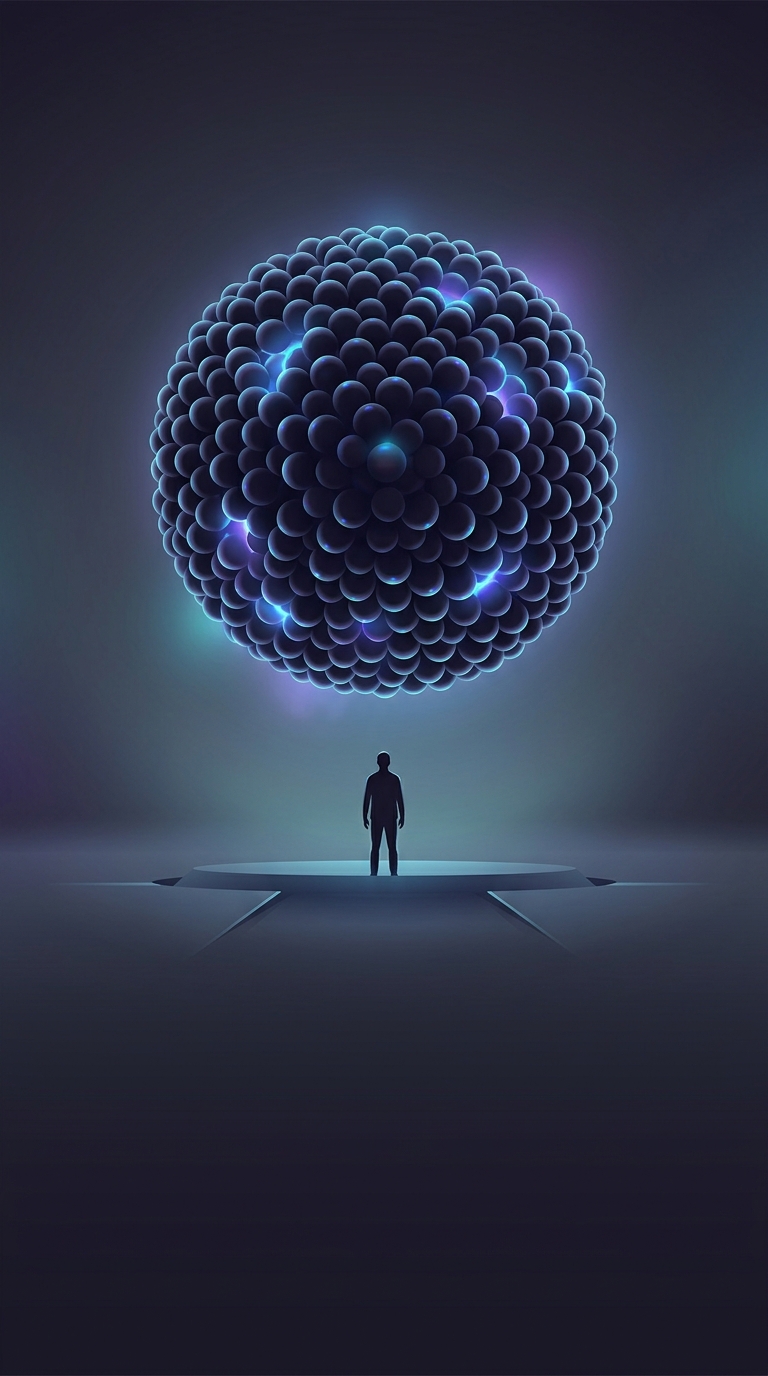
A rough answer is about two cubic centimeters—roughly the volume of a large grape. The estimate comes from comparing humanity’s total mass with the density of matter packed as tightly as it is inside atomic nuclei.
With roughly eight billion people and an average body mass on the order of 60 kilograms, all living humans together weigh about 500 billion kilograms. Nuclear matter is around 100 trillion times denser than ordinary water. At that density, 500 billion kilograms would occupy only a few millionths of a cubic meter: about two cubic centimeters.
“Empty space” is not an open gap
Atoms are often pictured as tiny solid centers surrounded by vast emptiness. In reality, an atom’s electrons form a spread-out quantum cloud, not little particles orbiting through a hollow shell. The atom’s size is largely set by that cloud, so shrinking atoms to nuclear dimensions means forcing their electrons and nuclei into an entirely different physical state—not simply squeezing out unused room.
At such extreme compression, electrons can be driven into protons, turning them into neutrons. Matter packed this way is associated with the interiors of neutron stars, where immense gravity helps hold it together. A grape-sized lump of humanity at nuclear density would not be a stable object sitting on Earth; maintaining that state requires extraordinary pressure.
The striking comparison is therefore a thought experiment, not a practical way to compact people: the tiny volume follows from nuclear density, while the conditions needed to create and hold it are the real catch.