Why a moonbow forms only in a narrow window
A moonbow is made by the same optics as a daytime rainbow. Moonlight enters raindrops, bends as it crosses the water, reflects inside the drops, then bends again as it leaves. Because different wavelengths bend by slightly different amounts, the emerging light is spread into a color band.
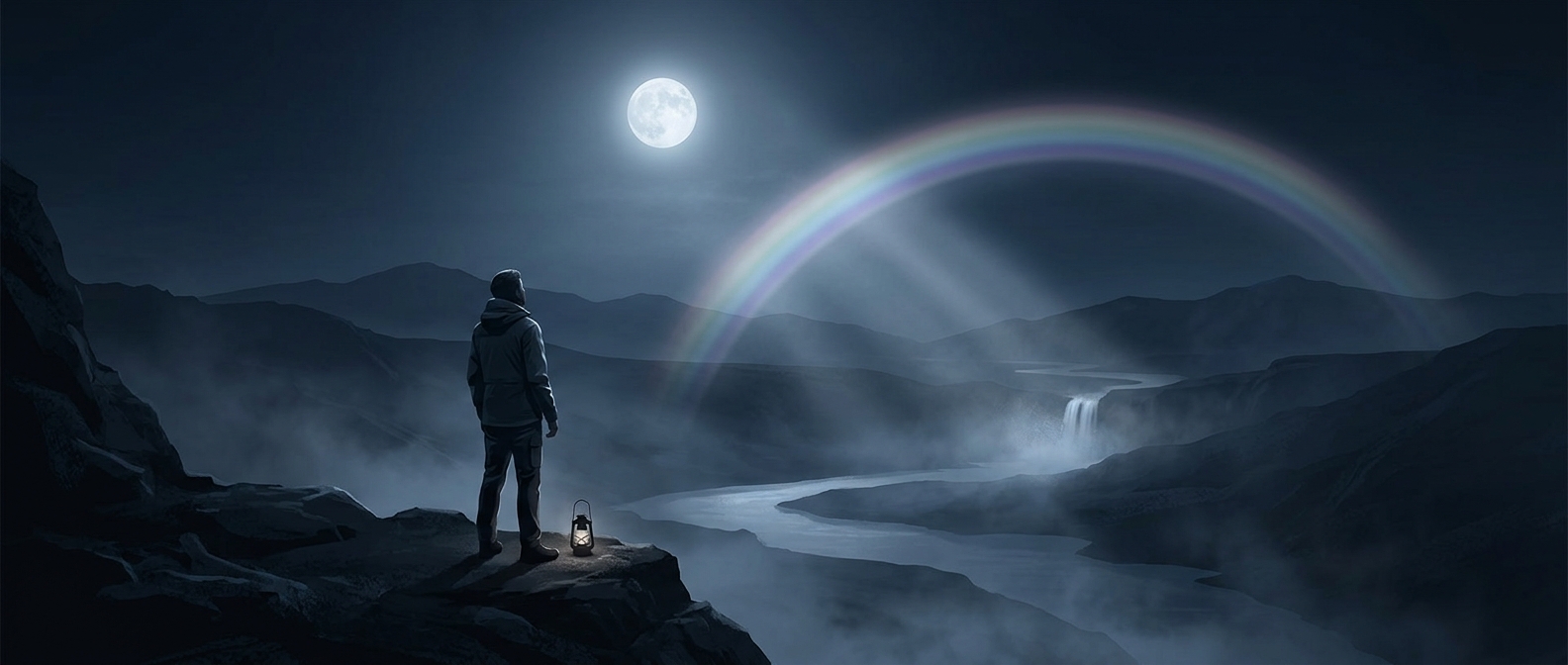
The geometry is precise: the Moon must be behind the observer, with rain in front. Each drop sends a particular color toward the eye at a particular angle, so together the drops trace an arc opposite the Moon. The Moon also needs to be low enough for that arc to rise above the horizon; otherwise, much of it falls below the viewer’s line of sight.
Why the arc can look nearly colorless
Even a bright Moon supplies far less light than the Sun. In dim conditions, the eye relies more on rod cells, which are good at detecting brightness but poor at distinguishing hues. The rainbow’s separated wavelengths are still reaching the eye, but the visual system may register the band mainly as pale light.
A camera can accumulate light over a longer exposure, letting its sensor record color that is difficult to see at a glance. That does not create the colors; it makes their faint differences easier to capture.
The best chance comes when a bright Moon, a dark sky, and rain in the right part of the sky coincide. A moonbow is therefore not just a nighttime rainbow—it is a brief alignment of light, droplets, and viewpoint.