Why empty space has no slower setting
Light’s vacuum speed is not the speed of a tiny object being held back by air—or the fastest setting of a mechanism that could shift lower. It is the speed at which electromagnetic changes propagate through empty space, set by the properties of space itself. In Einstein’s relativity, that speed, usually written as c, is the same for all observers moving at constant speed. There is no material in a vacuum to absorb, scatter, or delay the wave.
What changes when light enters glass
A material is not simply a clear corridor. Light’s electric field pushes on charged particles in its atoms, especially electrons. Those charges respond to the passing wave and, in turn, contribute electromagnetic waves of their own. The combined wave travels through the material with a delay compared with light in a vacuum.
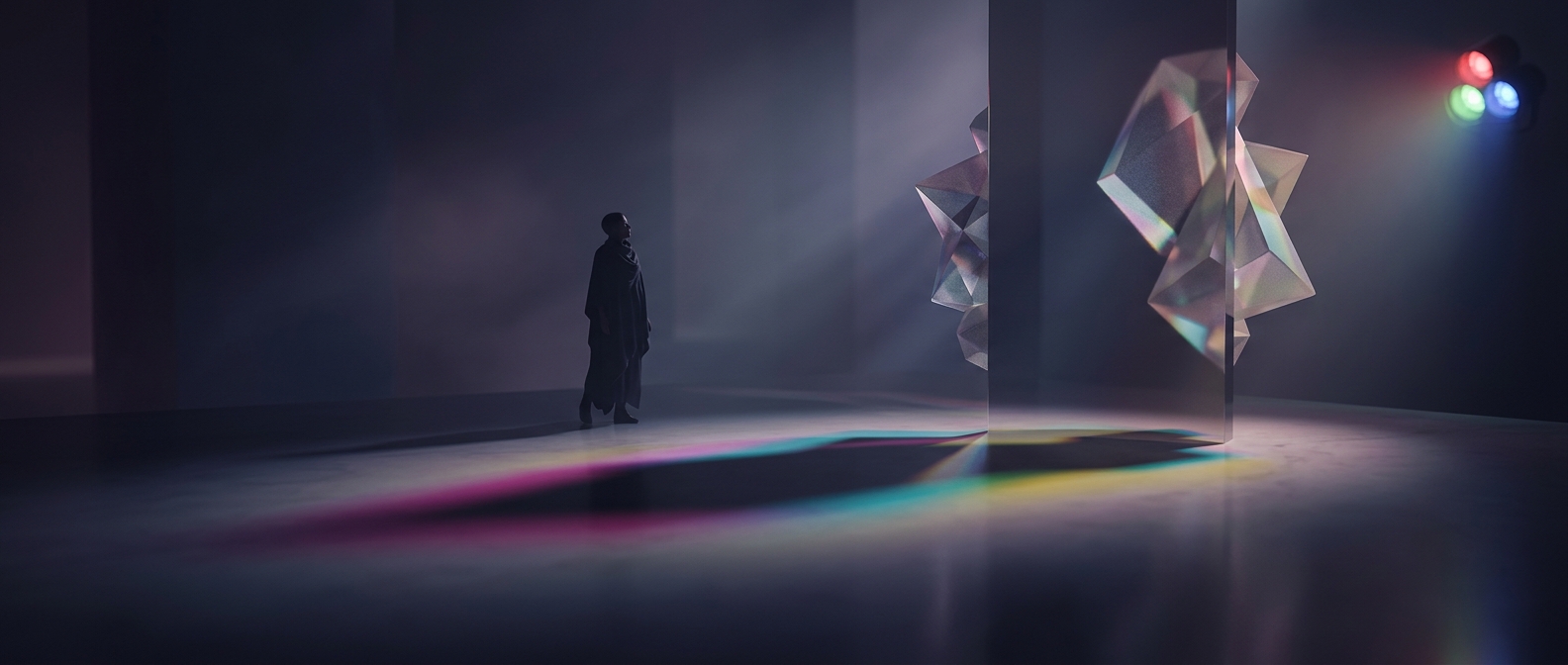
That delay makes light’s overall speed through a material lower. It is not best pictured as light repeatedly slamming into atoms and crawling between collisions: in transparent glass, the effect comes from the coordinated response of many charges. The exact response depends on the material and on the light’s frequency, which is why different colors can bend by different amounts in a prism.
A speed change, not a new vacuum speed
At a glass–air boundary, the change in wave speed changes the wave’s direction; this is refraction. When light leaves the glass and travels through vacuum again, its propagation returns to the vacuum value. The material has delayed the wave while it was inside, but it has not made empty space itself slower.
That distinction is useful whenever “light slows down” sounds mysterious: the delay belongs to the stuff light passes through, not to a lower gear hidden in a vacuum.