Why the Light Follows the Falling Water
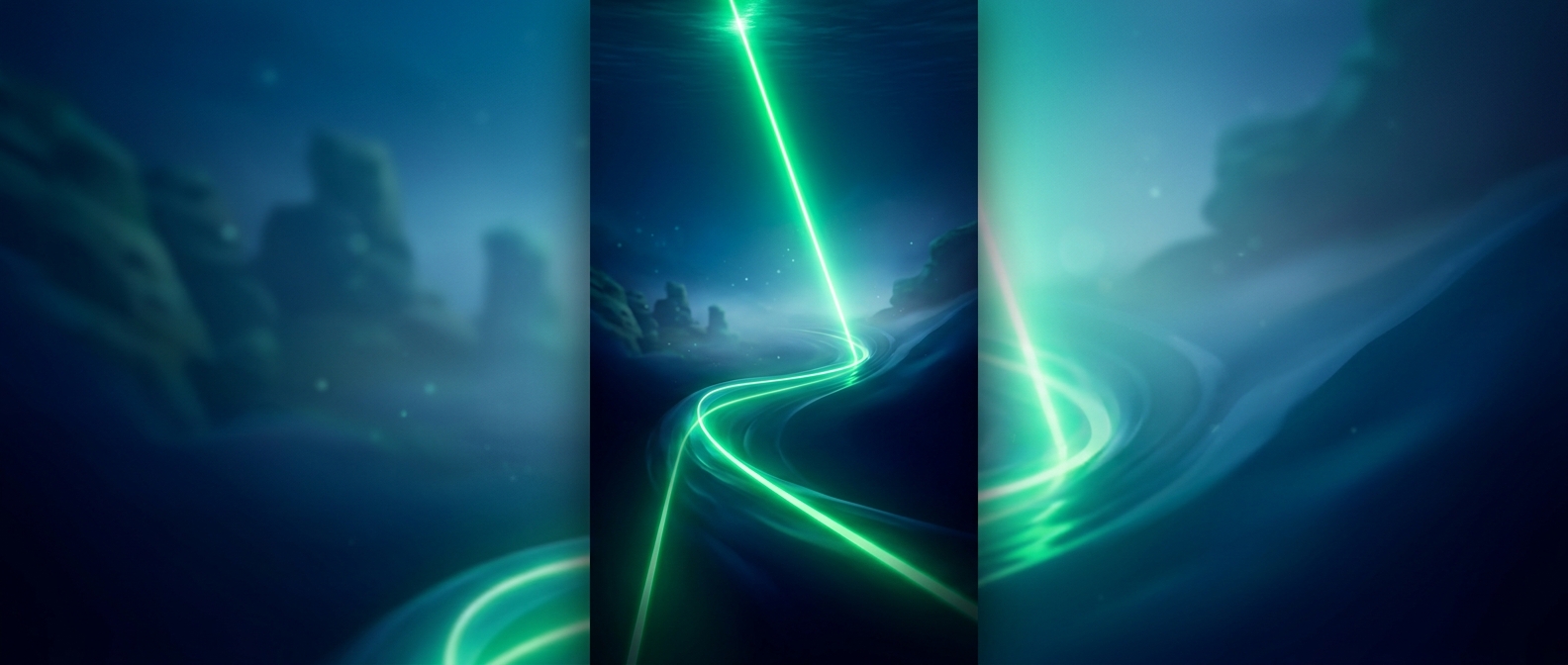
The trick depends on total internal reflection: when light traveling through water reaches the water–air boundary at a sufficiently shallow angle, it reflects back into the water instead of passing out. The same thing happens again at the opposite side of the stream, so the light zigzags between the boundaries as it travels.
Because the stream itself curves downward, those repeated reflections steer the light along its bend. The water is acting as a temporary guide, much like the glass core of a fiber-optic cable. For the effect to work, the laser must enter at an angle that sends it along the stream rather than straight through the water’s surface.
Why You Can See the Beam
Clear water does not normally make a beam’s path easy to see from the side. Tiny particles, bubbles, and disturbances in the falling stream scatter some of the light toward your eyes. That scattered light traces the stream’s curve; the rest remains guided inside until it reaches the end or escapes where splashing disrupts the boundary.
A Splashy, Imperfect Fiber
A glass fiber is designed to guide light steadily over long distances. A waterfall is rougher: turbulence, droplets, and changes in the stream’s shape interrupt the reflections and let light leak out. The demonstration works because the water-air boundary can guide light, but it also shows why a moving, splashing stream cannot replace a carefully made optical fiber.