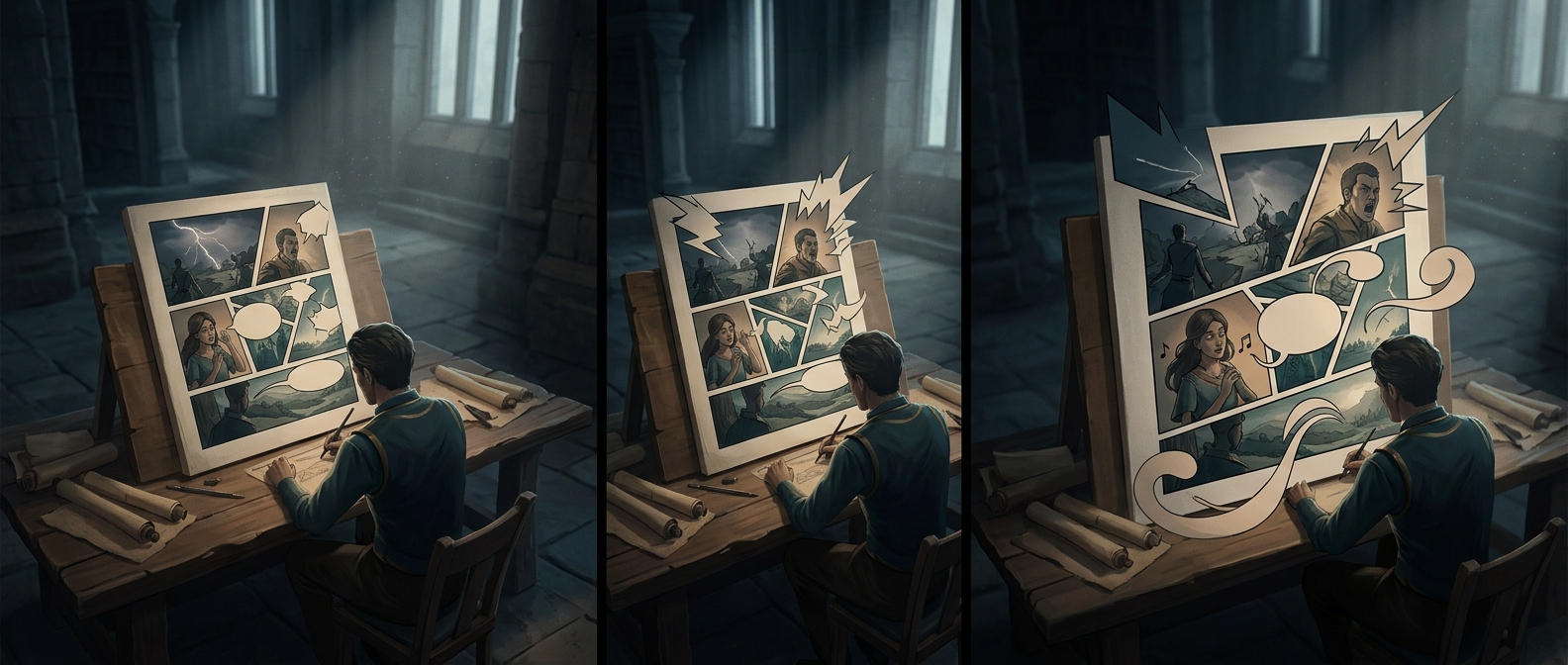
Balloon outlines act like a visual voice
Comics have to show not only what a character says, but how the words reach the reader. An ordinary balloon encloses dialogue in a stable, familiar shape. Change that outline, and the same words can feel louder, more forceful, or less like speech spoken aloud. A jagged edge makes the boundary look disturbed, giving a shout a visible burst of energy without changing the lettering.
Thought balloons solve a different problem. Their soft, cloudlike border marks the words as inward speech rather than something another character can hear. In many comics, a trail of small circles points back to the thinker, distinguishing the thought from a spoken balloon’s pointed tail.
A small shape changes how a panel reads
These outlines are part of comics’ visual grammar: readers learn to interpret recurring marks much as they learn to recognize words. The shape can steer a scene’s mood before the reader finishes the text. A character’s line in a jagged balloon may feel like an outburst; the same line in a thought balloon becomes private reflection.
That is especially useful in a medium built from still images. The artist can signal volume or interiority at a glance, preserving space for the drawing and letting the reader supply the imagined voice. The balloon is not just a container for dialogue—it tells the reader what kind of voice, if any, to hear.