Why a Long Train Cannot Be Treated Like One Long Rope
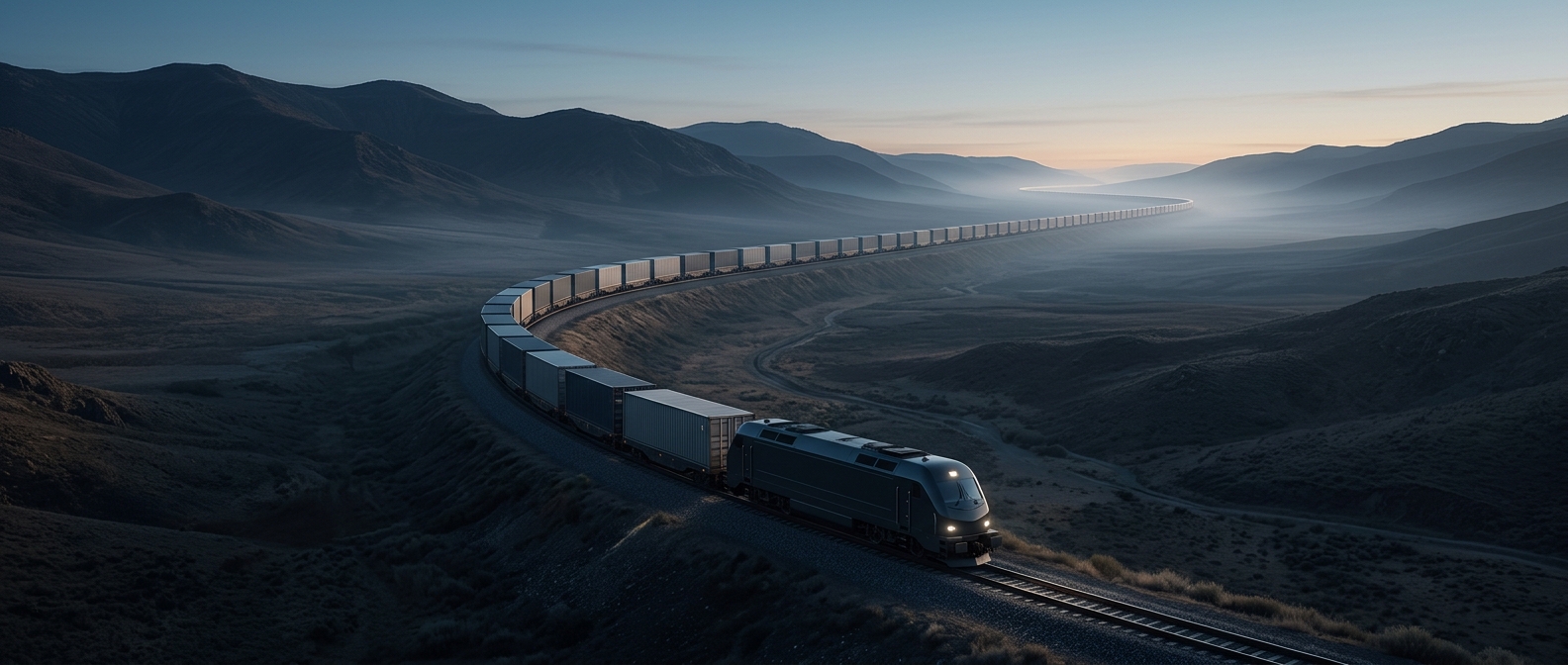
A freight train is a chain of heavy vehicles, not a single rigid unit. Each car is connected by a coupler with some play, so cars can bunch together or pull apart as the train starts, slows, or crosses uneven track. Those small movements travel through the train as waves of force. If a locomotive at the front has to accelerate every car behind it, the couplers near the front may carry the combined pull of a very long string of cars.
That strain can make handling difficult even when no coupler breaks. A sudden pull can jerk cars into motion unevenly; pushing too hard from behind can compress the line and increase the risk of cars buckling sideways on a curve or uneven section of track.
Locomotives Spread the Work
With distributed power, locomotives are placed at the front and at one or more points farther back. The crew controls the distant units remotely, coordinating their power with the lead locomotive. Instead of one engine pulling the entire train, several groups of cars are pulled or pushed along the route.
This divides the load on the couplers and can make acceleration and braking more controlled. It also helps keep forces from building up as sharply across the train. The locomotives do not eliminate the train’s movement; they help manage it by applying power at more than one point.
The Tradeoff Is Coordination
A train several miles long cannot react all at once. Signals to the locomotives, changes in track grade, and the timing of braking all matter because the front, middle, and rear may be experiencing different forces at the same moment. Operators must manage those forces while the train follows curves, climbs, and descends.
Distributed power makes very long trains more practical, but it adds equipment and coordination demands. Its central advantage is simple: the load is shared along the train instead of being concentrated at the front, reducing the strain that each section of couplers must endure.