The Tie Is Part of the Vibration Path
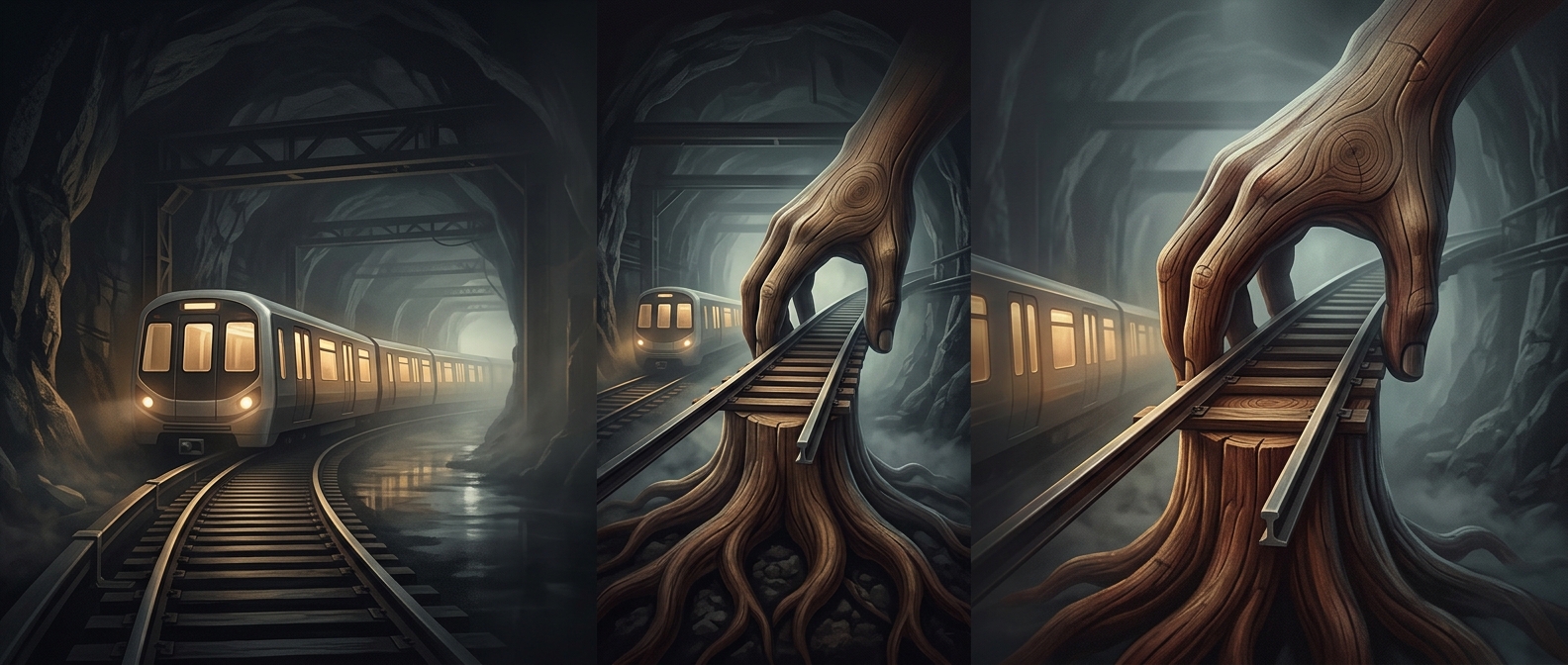
A passing train sends force into the track at every wheel: the wheel presses and rattles against the steel rail, and the rail passes that motion into whatever supports it. A wooden tie—the crosspiece beneath the rails—adds a slightly yielding layer between the steel and the tunnel structure.
Wood flexes a little under repeated loading. Some vibration energy is dissipated as the material deforms and rebounds, rather than traveling directly into the track bed and tunnel lining. The effect is not a soundproof barrier; it is a way to reduce how strongly some of the train’s motion is transmitted into the surrounding structure.
Support Without a Perfectly Rigid Connection
Ties also hold the rails at the correct spacing and spread wheel loads across a broader area. That support must be firm enough to keep the track stable, but a track assembly need not be equally rigid at every point. The tie’s modest give helps soften the mechanical connection between rail and tunnel.
That distinction matters underground. Vibrations entering a tunnel can travel through its structure and be felt or heard beyond the track itself. Reducing the force passed along at the rail supports can therefore help limit the rumble reaching nearby spaces.
A Tradeoff, Not a Cure-All
Wood is not the only way to manage vibration: track systems can also use resilient pads or other flexible components. Nor does a wooden tie eliminate the noise made by a train. Wheel condition, rail joints, speed, and the rest of the track structure all affect what people hear and feel.
The useful feature of the wooden tie is its combination of jobs: it supports and spaces the rails while giving the track a little more compliance. That small amount of movement is why a seemingly ordinary crosspiece can make a difference to how much subway rumble reaches the ground around it.