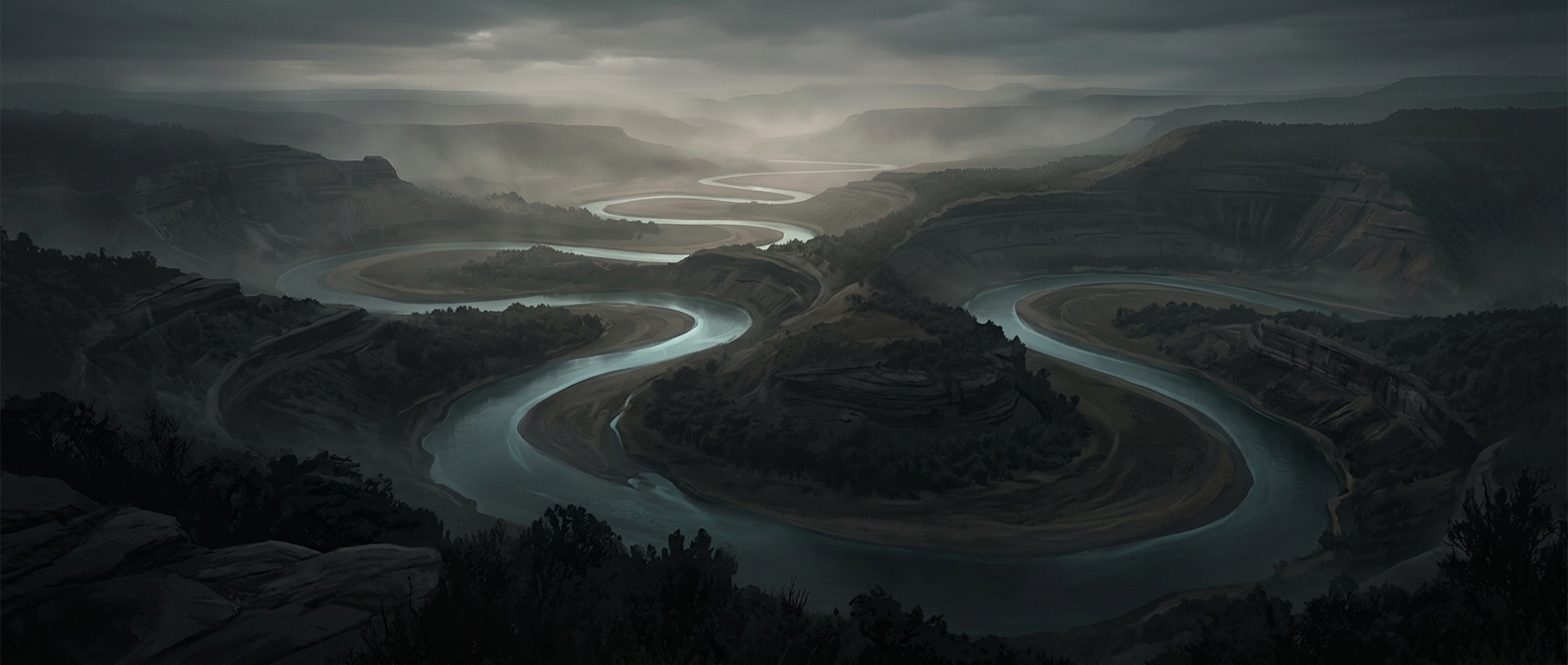
How a small bend becomes a big loop
A river does not flow at the same speed across its width. In a bend, the fastest current is pushed toward the outside of the curve, where it wears away the bank. Along the inside, slower water loses energy and leaves sediment—sand, silt, and mud—behind. This paired action gradually moves the bend outward and downstream, making it more pronounced.
Why the river eventually takes a shortcut
As the loop expands, the strip of land between its two approaching sides—the neck—gets narrower. During high water, the river can break across that neck instead of following the longer curved route. The shortcut gives the main current a straighter path, and the old bend is cut off from the river’s flow.
That change can happen suddenly compared with the slow erosion that shaped the loop. Once the river abandons the curve, sediment often begins to seal its entrances. The remaining water forms an oxbow lake, named for its curved, bow-like shape.
A river’s former route remains visible
Oxbow lakes are traces of a river changing course. Some gradually fill with sediment or shrink as water evaporates, while others persist as distinct wetlands. From above, a crescent of water beside the present channel can reveal where the river once flowed—its long loop compressed into a small record of a much larger shift.