Why frozen water counts as a mineral
“Mineral” sounds like a word reserved for rocks, but geologists use it for naturally occurring solids with an orderly internal structure and a characteristic chemical composition. Ice meets those criteria: it is solid water, and its molecules arrange themselves in a repeating lattice—a pattern that continues through the crystal rather than stopping at its surface.
That distinction is about structure, not appearance. A piece of clear ice and a delicate snow crystal can look radically different, yet both are made of the same mineral, ice. The familiar snowflake is usually a single crystal, while snow on the ground is a loose collection of many crystals, often mixed with air and altered by melting and refreezing.
How a cloud builds a snow crystal
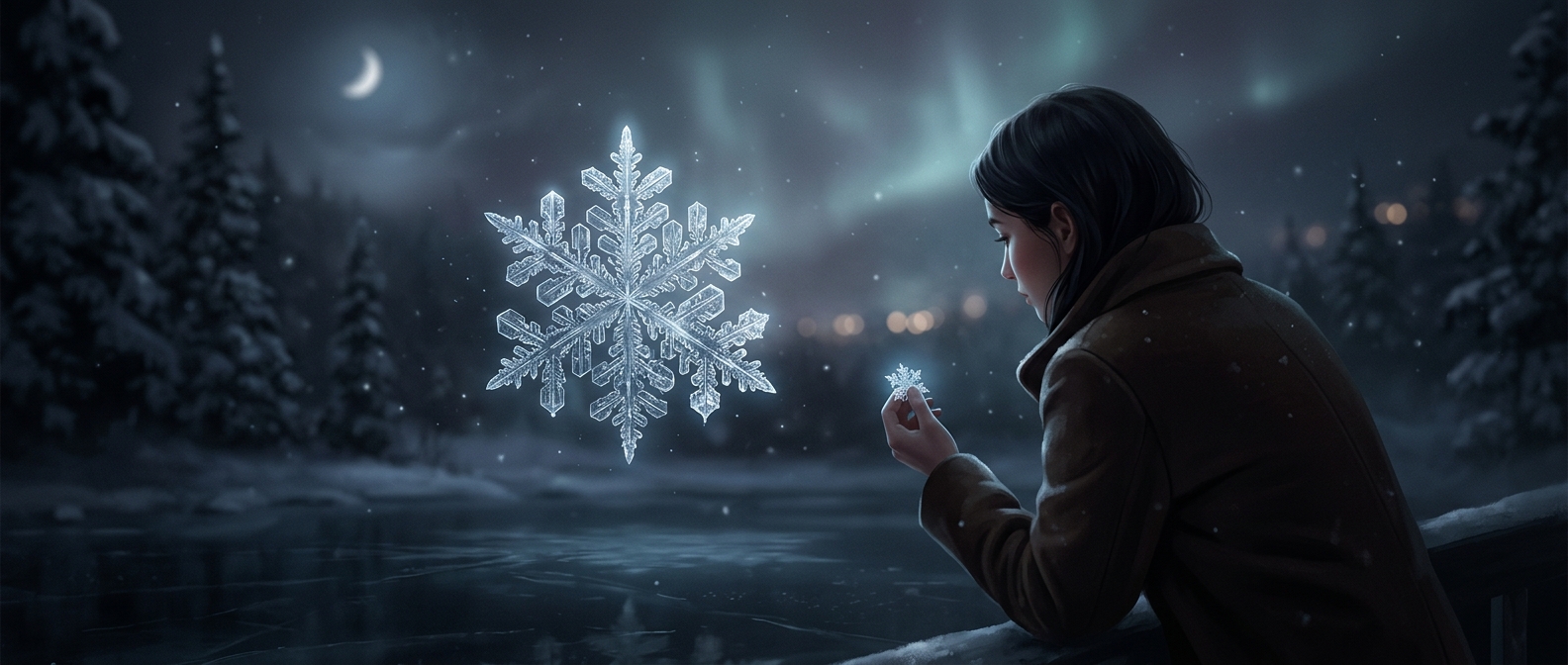
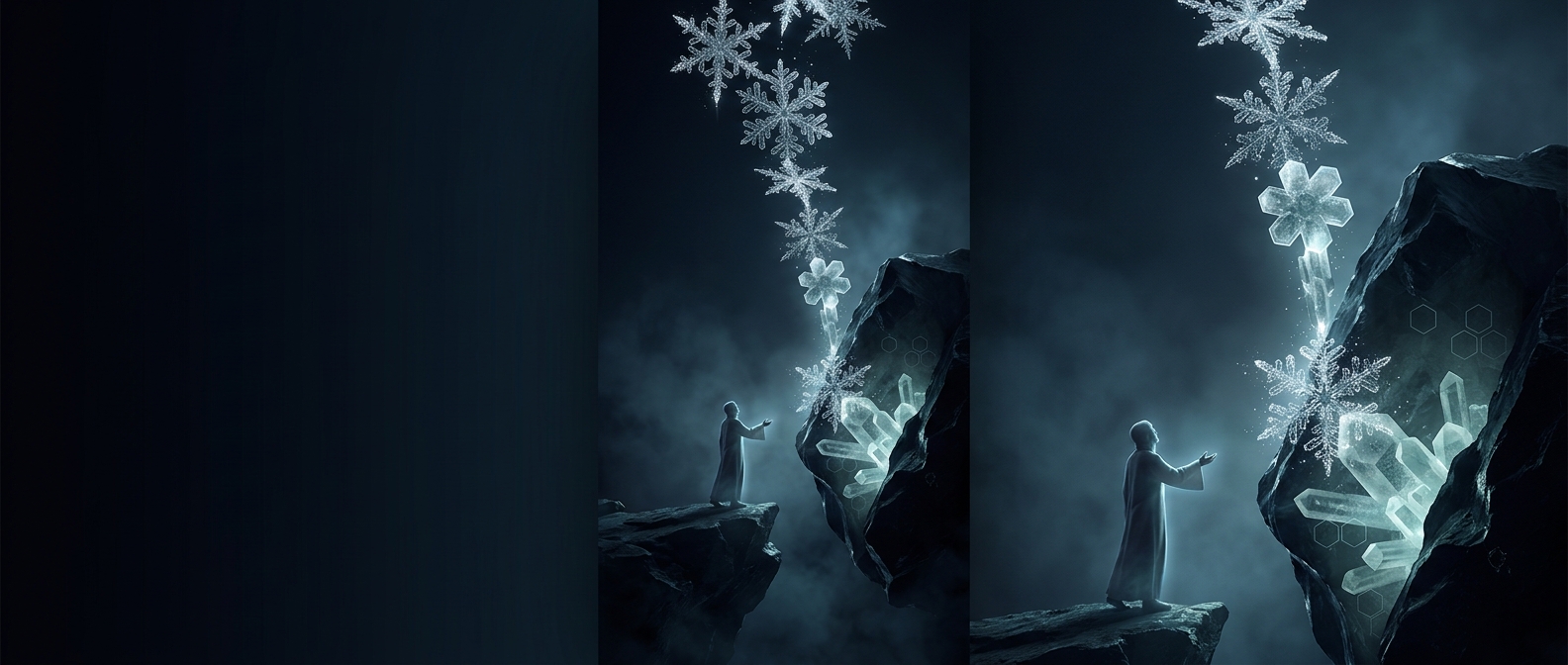
A snow crystal begins when water vapor in a cold cloud deposits directly onto a tiny particle, such as dust. As more water molecules join the growing solid, they follow the arrangement of the existing lattice. Under ordinary atmospheric conditions, that arrangement favors six-sided symmetry, which is why snow crystals commonly develop six arms or facets.
The branching pattern is shaped by the crystal’s changing surroundings. Temperature and the amount of water vapor affect which faces grow fastest. A crystal may pass through layers of cloud with different conditions as it falls, so its branches can widen, split, or sprout finer features. Its intricate outline records that growth, but the underlying structure remains a regular arrangement of ice molecules.
A mineral in a temporary form
The mineral identity does not mean every snowflake is a perfect, isolated sculpture. Crystals collide, break, clump together, and gradually change shape after landing. A snowbank is therefore a shifting mass of ice crystals and trapped air—not a single enormous crystal. Its softness comes largely from the spaces between those crystals, even though the solid material in each one is mineral ice.