How Falling Water Can Build a Spark
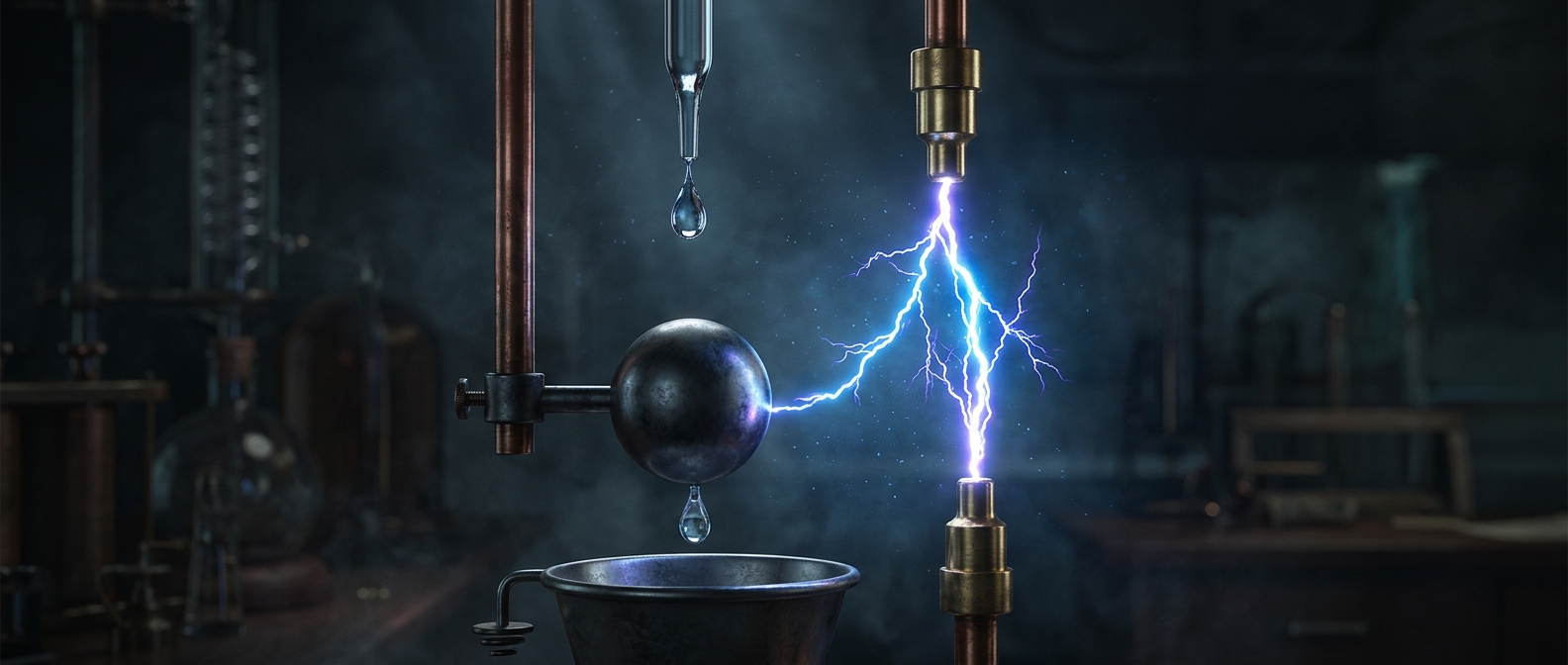
A stream of water is electrically neutral overall, but its positive and negative charges can be nudged apart. In this demonstration, water falls through rings that are electrically connected to buckets on opposite sides of the setup. As the stream passes through a ring, tiny charge imbalances in the water help change the charge on that ring and its connected bucket.
A Small Imbalance Becomes a High Voltage
The arrangement links each side of the falling stream to the opposite side’s electrical buildup. That feedback makes the charge separation grow: one side becomes increasingly positive while the other becomes increasingly negative. The effect is modest at each pass, but repeated transfers accumulate until the voltage—the electrical difference between the two sides—can exceed 10,000 volts.
Voltage is not the same as the amount of electricity flowing. A high voltage means there is a strong push for charge to move, even when the total charge involved is small. That is why a compact apparatus can produce a visible spark without behaving like a powerful electrical supply.
Why the Spark Crosses Air
Normally, air acts as an insulator, keeping charge from moving freely between the two sides. But when the electric field becomes strong enough, it strips electrons from some air molecules. The resulting charged particles let electricity travel through the gap, briefly turning the air into a conductor. The sudden discharge is the spark.
The water’s role is to keep separating and accumulating charge; it does not need to bridge the gap itself. The final leap happens through the air, which is why a falling stream can set up a flash without becoming a continuous electrical wire.