How a Game Turns Coordinates Into a World
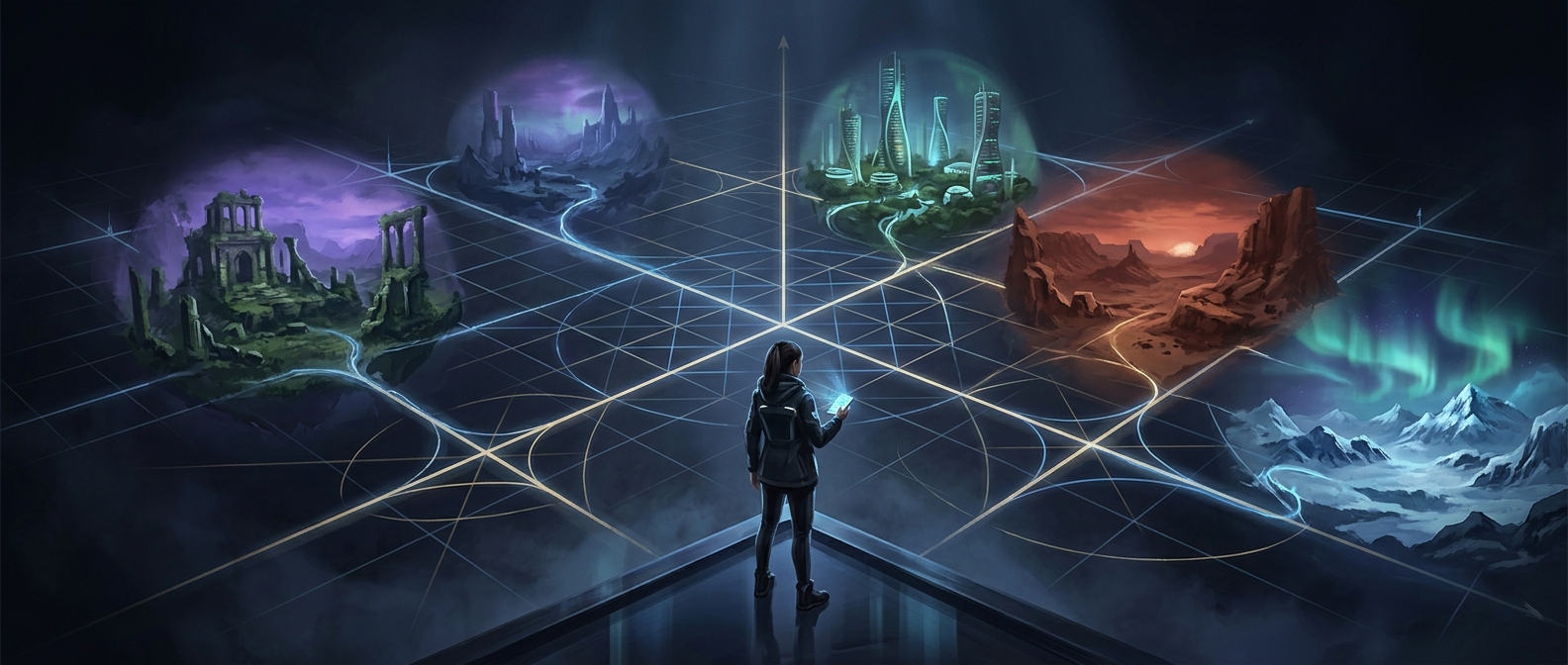
A game can describe a location with just three numbers: how far it is along the left–right, up–down, and forward–back directions. Together, those numbers form a position in a coordinate system. The system gives the computer a consistent way to place the player, a doorway, or a distant mountain without storing a separate image for every possible viewpoint.
Movement Changes the Numbers
When a character walks forward, the game changes the character’s position along one or more directions. The same principle applies to objects: a door stays at its assigned position, while the character’s position changes relative to it. This lets the game calculate whether the character is near enough to touch the door, pass through it, or see it.
A world may also use additional information—such as an object’s size and orientation—to describe more than its location. But coordinates provide the shared spatial framework that lets those pieces fit together.
The Camera Makes a View
The camera has a position and direction of its own. To draw a frame, the game works out which parts of the world fall within the camera’s view, then projects those three-dimensional positions onto a flat screen. As the camera or character moves, the visible view changes; the world does not have to be rebuilt as a new picture each time.
That separation is what makes a large, explorable space practical: the game stores a world as placed objects and relationships, then renders the slice the player is looking at. The screen is a view of the world’s coordinates, not the world itself.