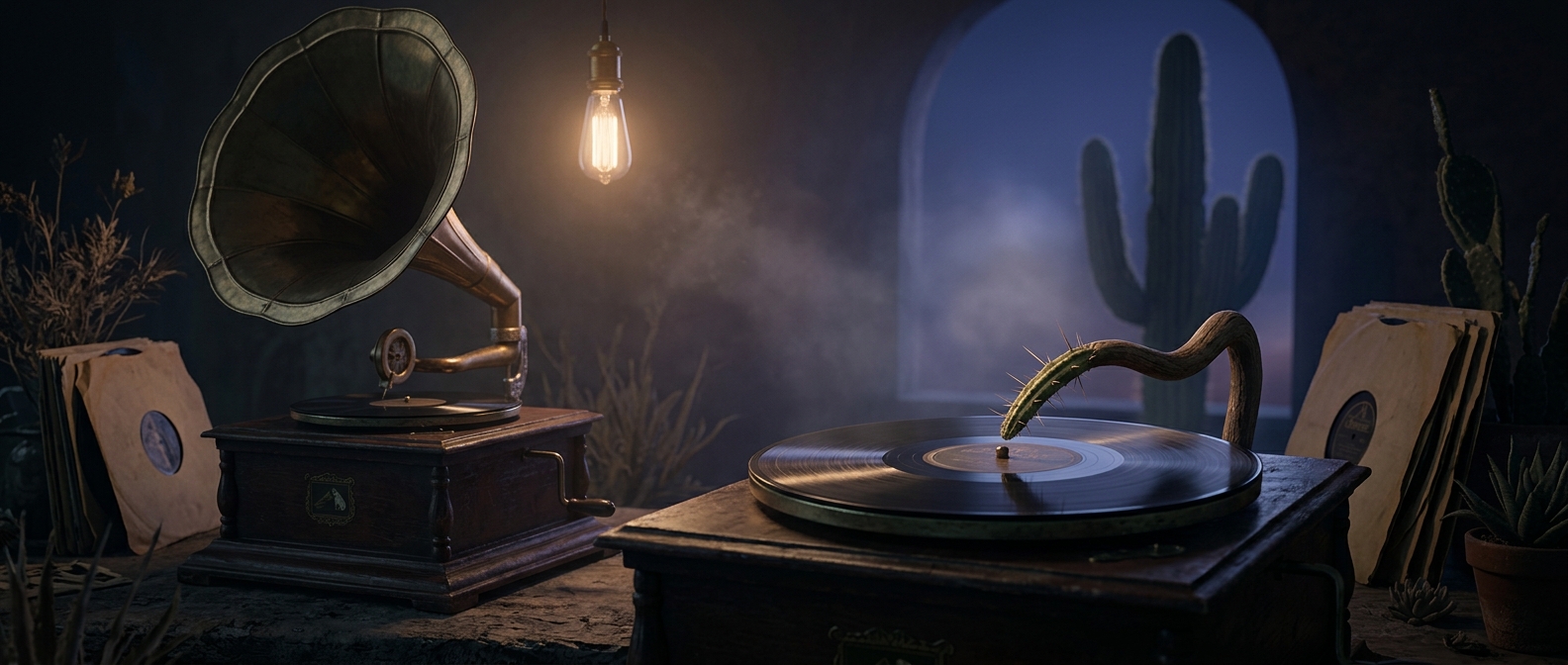
How a groove becomes a sound signal
A record’s groove is a continuously changing path, not a row of separate marks for individual notes. When a recording is made for vinyl, an engraving stylus moves in response to the audio signal and cuts that changing path into a master disc. Copies preserve its shape as a spiral, running from the record’s outer edge toward its center.
During playback, the cartridge at the end of the tonearm holds the needle, or stylus, in the groove. As the stylus moves, it shifts a tiny magnet or coil inside the cartridge. That motion produces a changing electrical voltage corresponding to the recorded sound. An amplifier strengthens the signal so speakers can turn it back into moving air.
One groove can carry two channels
Stereo records encode left- and right-channel sound in the two angled walls of the groove. The stylus’s movement across those walls lets the cartridge recover both channels at once. This arrangement fits stereo information into a single spiral rather than requiring a separate track for each speaker.
The groove also has to balance competing demands. More space between turns can allow wider, louder movements, but uses up the record’s playing area; tighter spacing makes room for more music, while limiting how much the groove can swing. The result is a physical recording whose sound depends on a delicate chain: a precisely cut path, a freely moving stylus, and a cartridge able to translate that motion into an electrical signal.