How a Key Creates a Clear Path Through a Lock
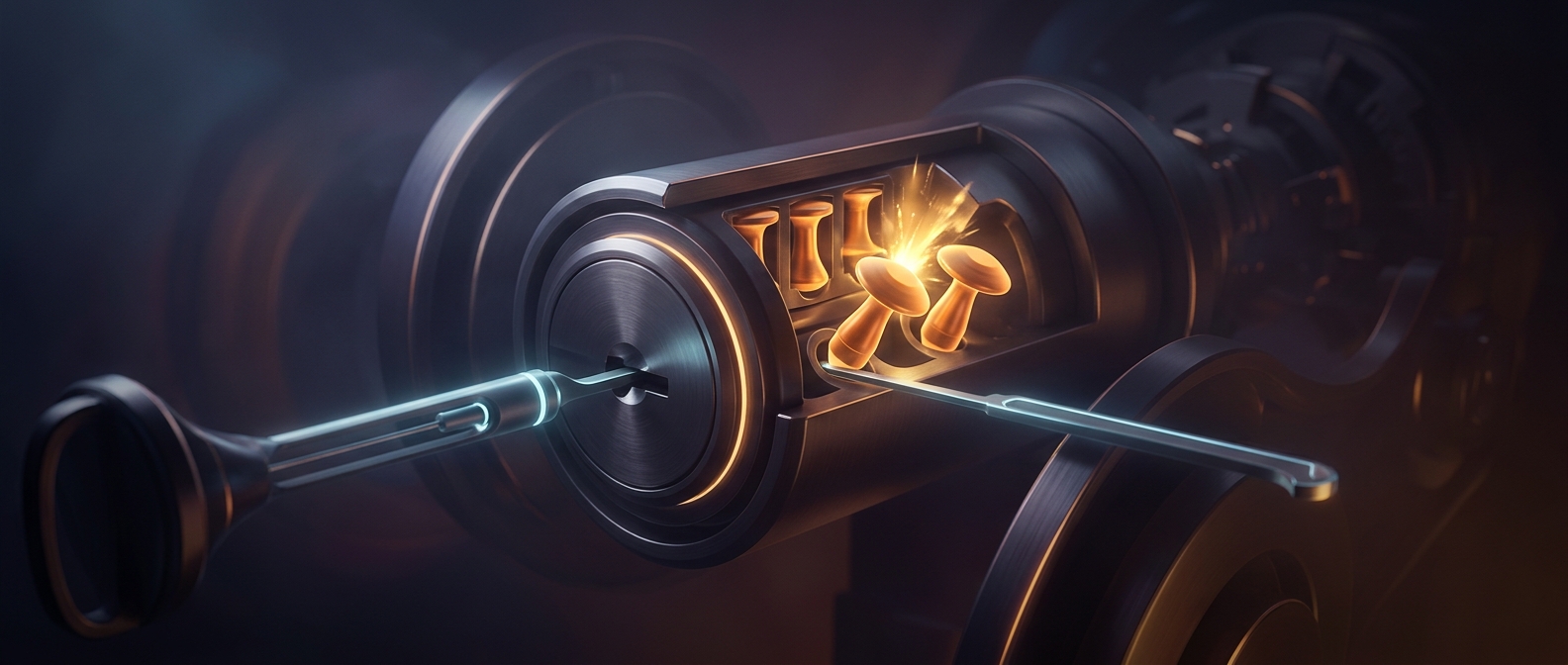
A pin-tumbler lock contains a rotating inner cylinder, called a plug, inside a fixed outer casing. Each narrow hole through the plug holds a pair of pins: a lower pin that rests on the key and an upper pin pushed downward by a spring. With no key inserted, the upper pins extend across the boundary between plug and casing. That boundary is the shear line, and the pins crossing it keep the plug from rotating.
A key’s uneven edge is a carefully arranged set of heights. As the key slides in, its peaks lift the lower pins by different amounts. The key works when each lower pin rises just enough for the top of its pair—the meeting point between lower and upper pins—to sit at the shear line. The upper pins then remain in the casing, while the lower pins remain in the plug. Nothing bridges the boundary, so the plug can turn.
Why the Wrong Key Stops the Plug
If a key lifts one pin pair too little, an upper pin still crosses the shear line. If it lifts a pair too far, a lower pin crosses it instead. Either way, the pin acts like a small bar wedged between the rotating plug and stationary casing. The plug cannot turn freely, even if the key fits into the slot.
Turning the plug moves a mechanism that retracts the lock’s bolt. When the key is withdrawn, the springs push the pins back down, restoring the blocking arrangement. The lock’s security comes from making the key match the height pattern across all the pin pairs: one misplaced pin is enough to keep the entire cylinder from turning.