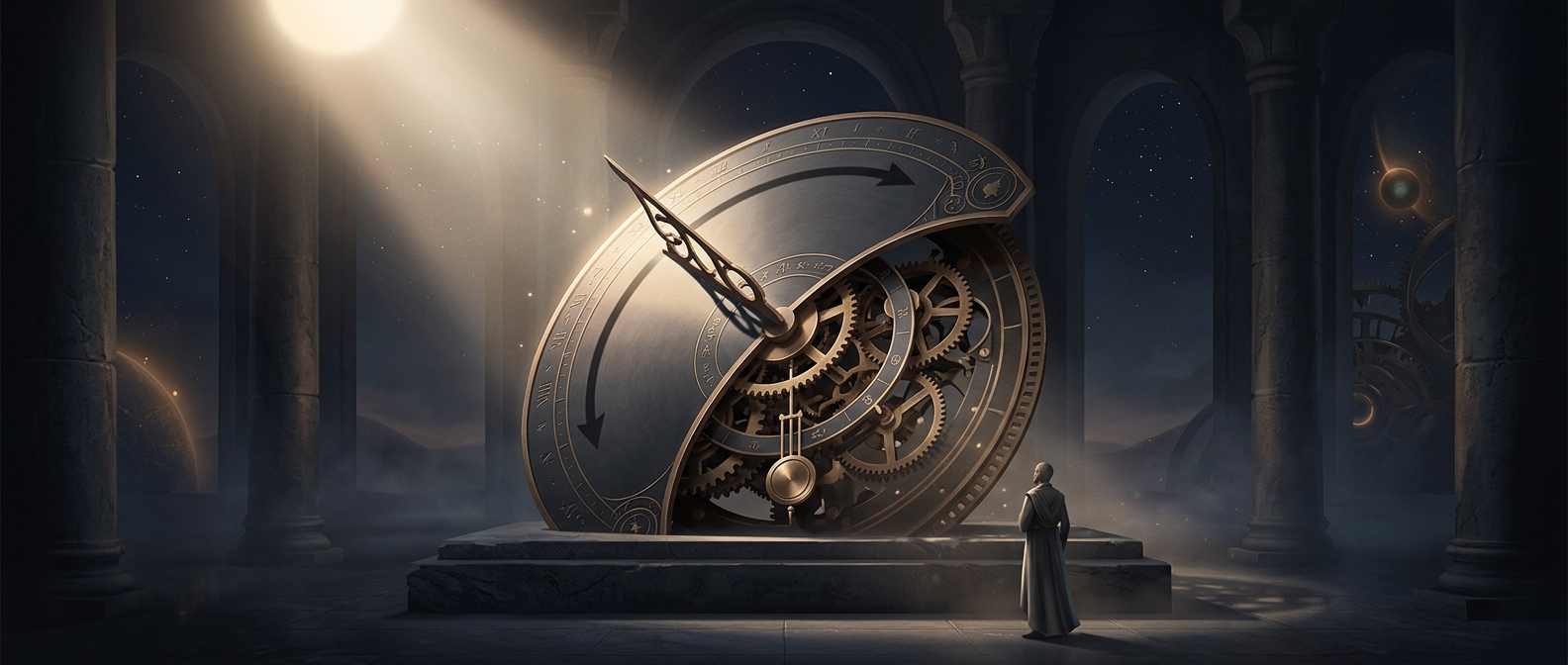
Why a sundial’s shadow moves clockwise
A horizontal sundial turns the Sun’s apparent motion across the sky into a moving shadow. In the Northern Hemisphere, the Sun appears to travel from east to south to west. A sundial’s upright pointer—called a gnomon—casts its shadow in the opposite direction, tracing the hours around the dial from morning through afternoon. On the familiar layout, that path runs clockwise.
The direction is not built into time itself. It follows from how the dial is oriented: its hour marks are arranged to match the shadow’s path as the Sun crosses the southern sky. A sundial made for the Southern Hemisphere generally has a different layout, because the Sun passes through the northern sky there.
Mechanical clocks borrowed a familiar display
When mechanical clocks began to take over timekeeping, people already knew how to read sundials. Clockmakers could make a new device easier to understand by placing its hour marks in the same order and having its hand follow the same apparent route as a sundial shadow. The hand’s circular sweep became a familiar convention, later reinforced by clocks spreading through everyday life.
That convention could have been different. A clock face can be designed with its numbers in the opposite order and its hands moving counterclockwise; the mechanism can still measure time. But matching the established sundial pattern made clocks immediately legible to people who had learned to tell time from the Sun. What now feels like a natural direction is, in part, an old interface decision that became standard through use.