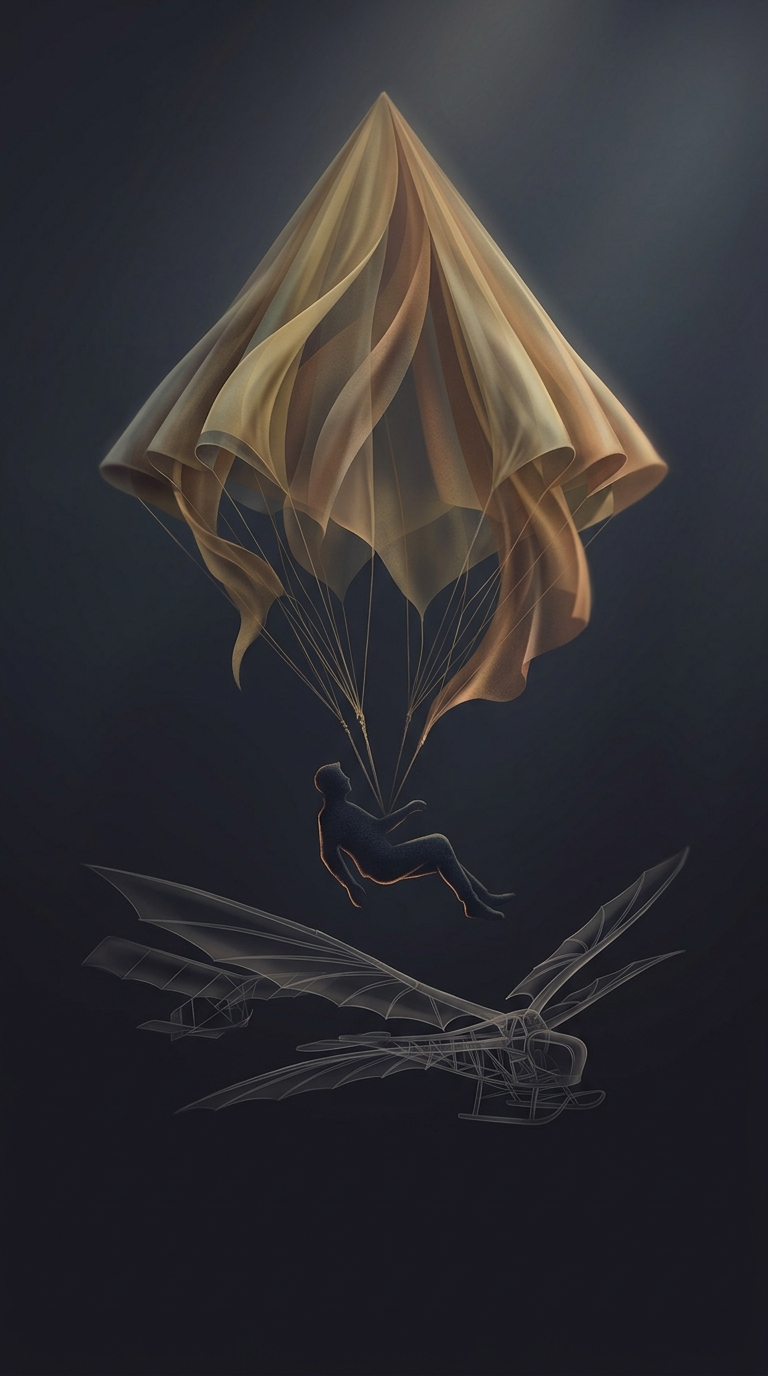
A parachute solves a different problem from an airplane
A parachute does not need an aircraft to work. It needs height, a person or object falling through air, and a canopy large enough to push against that air. As the canopy opens, it increases drag—the force of air resistance opposing the fall—so the descent slows toward a speed at which drag balances the pull of gravity.
That basic mechanism made the parachute a plausible invention long before powered flight. People could test it by jumping from elevated structures or descending from balloons; neither required an airplane. The challenge was not simply to make a piece of cloth catch air, but to make it open reliably, support the falling load, and slow the descent without tearing or entangling its user.
The canopy came before the aircraft
Early parachute designs explored how shape and suspension could turn a fall into a controlled descent. A broad canopy gathers air, while lines connect it to the person or payload below. The balance matters: too little resistance leaves the fall dangerously fast, while an unreliable opening can make the device useless at the moment it is needed.
This gave parachutes a practical purpose of their own. Balloonists could face danger high above the ground, and a parachute offered a possible way down even when no powered airplane existed. In that sense, the device was not an accessory waiting for aviation to arrive; it was a separate answer to the older problem of surviving a fall from height.
Powered flight gave parachutes a new job
Once airplanes could carry people into the sky, the parachute’s role shifted from descending from a balloon or other elevated position to escaping a disabled aircraft. The underlying physics did not change. What changed was the setting: pilots now needed a device that could be carried aloft, deployed in an emergency, and opened in the airflow around an aircraft.
The sequence is a reminder that inventions do not always arrive in the order their later uses suggest. The parachute’s central trick—trading a wide canopy for a slower fall—was workable before there was an airplane to jump from.