How a fairground became a small payment system
The 1933 Chicago World’s Fair had a problem larger than selling admission: it needed to keep construction and daily operations moving while the banking system was in turmoil. When ordinary money was difficult to access or transfer, waiting for normal payments could leave contractors and vendors unable to pay workers or suppliers.
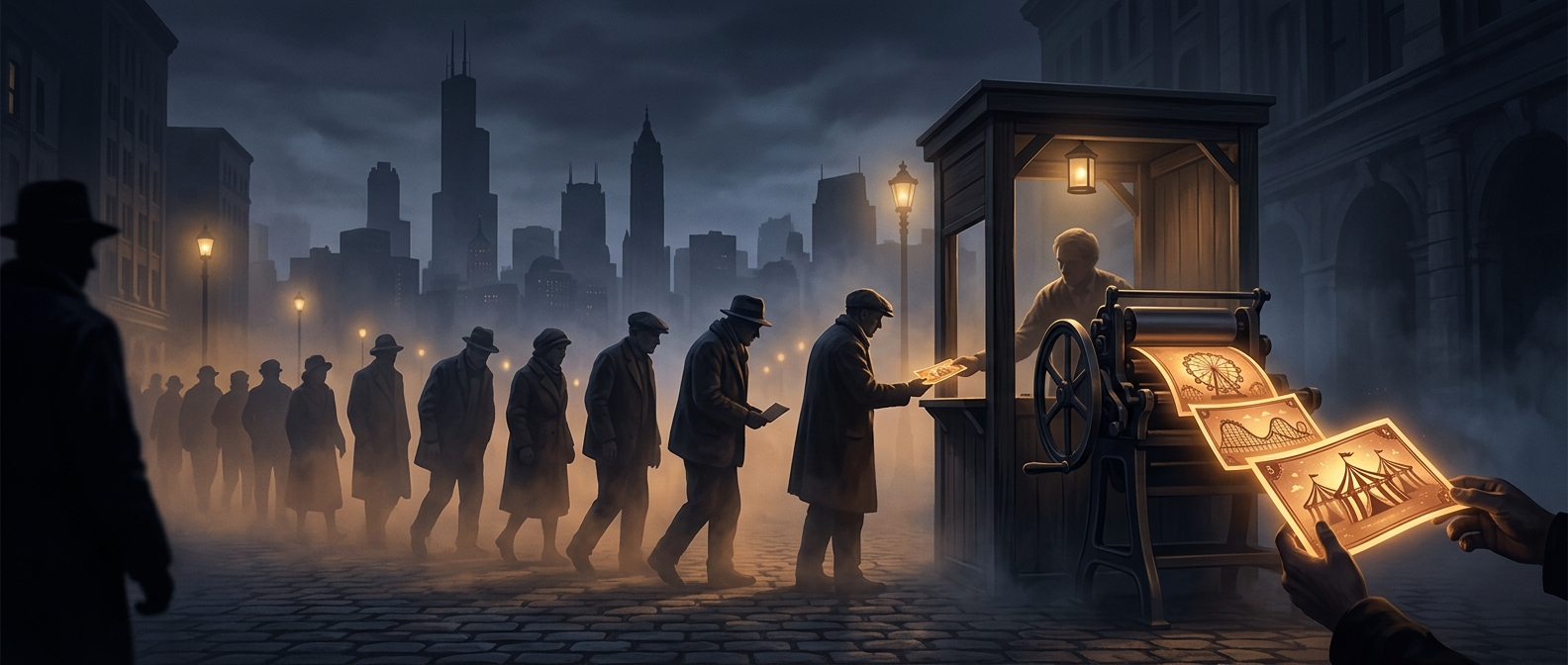
The fair answered with scrip—temporary paper money issued by an organization rather than a government. Instead of paying every obligation in cash, the fair could issue its own notes, which recipients agreed to accept for payments connected to the exposition. That gave the fair a way to settle bills even when banks could not reliably perform their usual role.
Why anyone would take it
Scrip works only if people believe they can use it or exchange it for something of value. The fair’s notes mattered because the exposition itself was a large, active marketplace: vendors had ongoing business there, and contractors and workers needed to transact with one another. If recipients expected the fair to honor the notes, taking them could be more useful than waiting for cash that was temporarily hard to obtain.
That trust had limits. Fair money was not a general replacement for dollars; its usefulness depended on acceptance within the fair’s economic orbit and on confidence in the issuer. The arrangement shifted the immediate question from “Can the bank provide cash today?” to “Will the fair and its participants honor this note?”
In effect, the exposition created a temporary payment network inside a national financial emergency. Its paper currency helped keep work and trade going on the fairgrounds, showing how a major organization could use its own promise to bridge a gap when the usual channels of payment faltered.