A parlor that quietly becomes an elevator
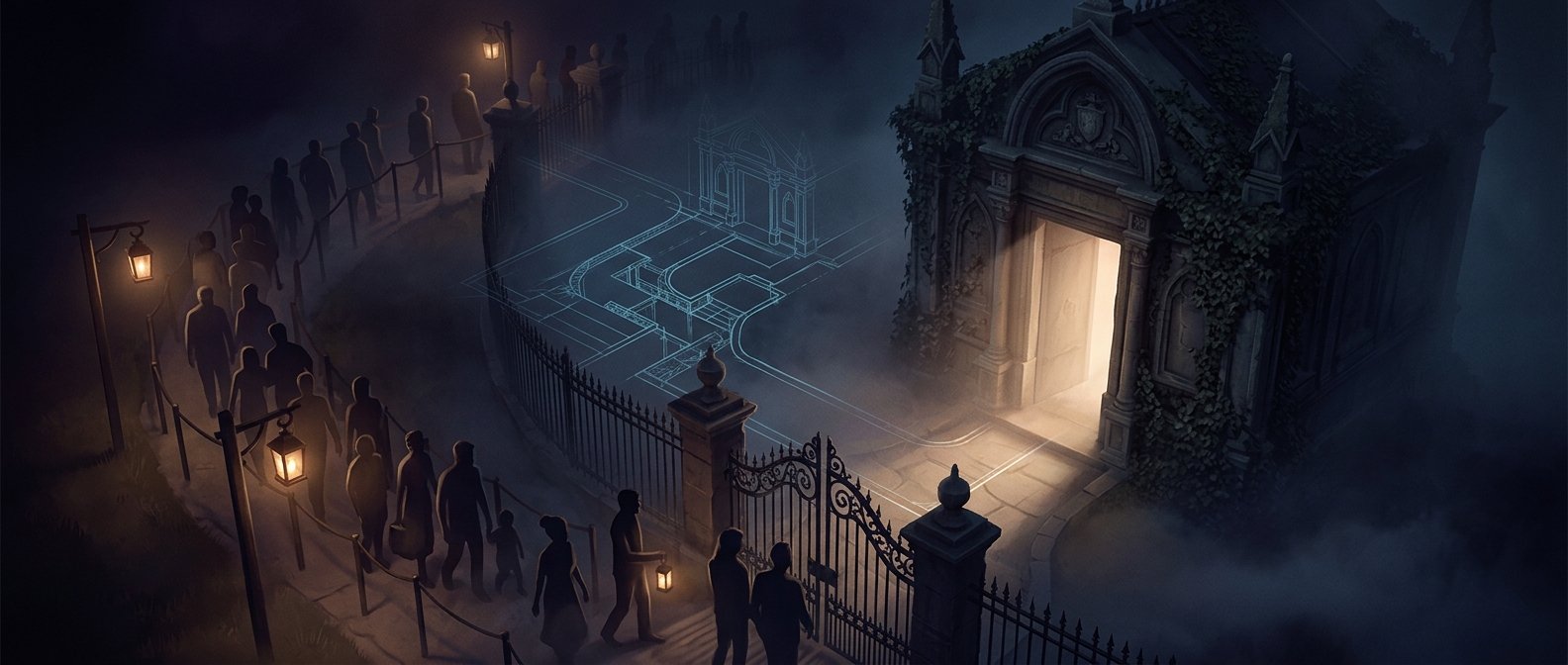
At Disneyland’s Haunted Mansion, the stretching room does more than set a mood: it carries guests downward. The chamber is a disguised elevator, and its descent moves the group below the park’s railroad tracks. From there, guests can reach the ride building, which sits beyond the landscaped boundary known as the berm.
That arrangement solves a practical site problem. The mansion’s visible façade stands inside the park, but the larger ride structure is outside the berm. Rather than send guests outdoors or route them across the train tracks, the attraction takes them underneath.
Making machinery feel supernatural
The descent is staged as part of the room’s impossible transformation. As the elevator platform lowers, the space appears to grow taller, while portraits on the walls reveal figures in increasingly elongated, unsettling poses. The machinery is doing a straightforward job—lowering a crowd—but the changing perspective gives that movement a story: the room itself seems to stretch beyond normal limits.
The sequence also manages the transition between the mansion’s small, theatrical interior and the ride’s backstage-scale layout. Guests remain together in a controlled space while the elevator moves, then continue through a passage toward the attraction. The necessary travel becomes part of the show instead of an interruption.
The illusion has a practical payoff
The trick works because the room’s two purposes are inseparable. Its eerie proportions give guests something to watch, while the elevator quietly relocates them beneath a major park boundary. What feels like a supernatural expansion is also a piece of crowd-moving architecture—one that lets the ride’s story carry guests from the mansion façade to a building that could not fit behind it.