Why a Loop Needs a Wider Bottom
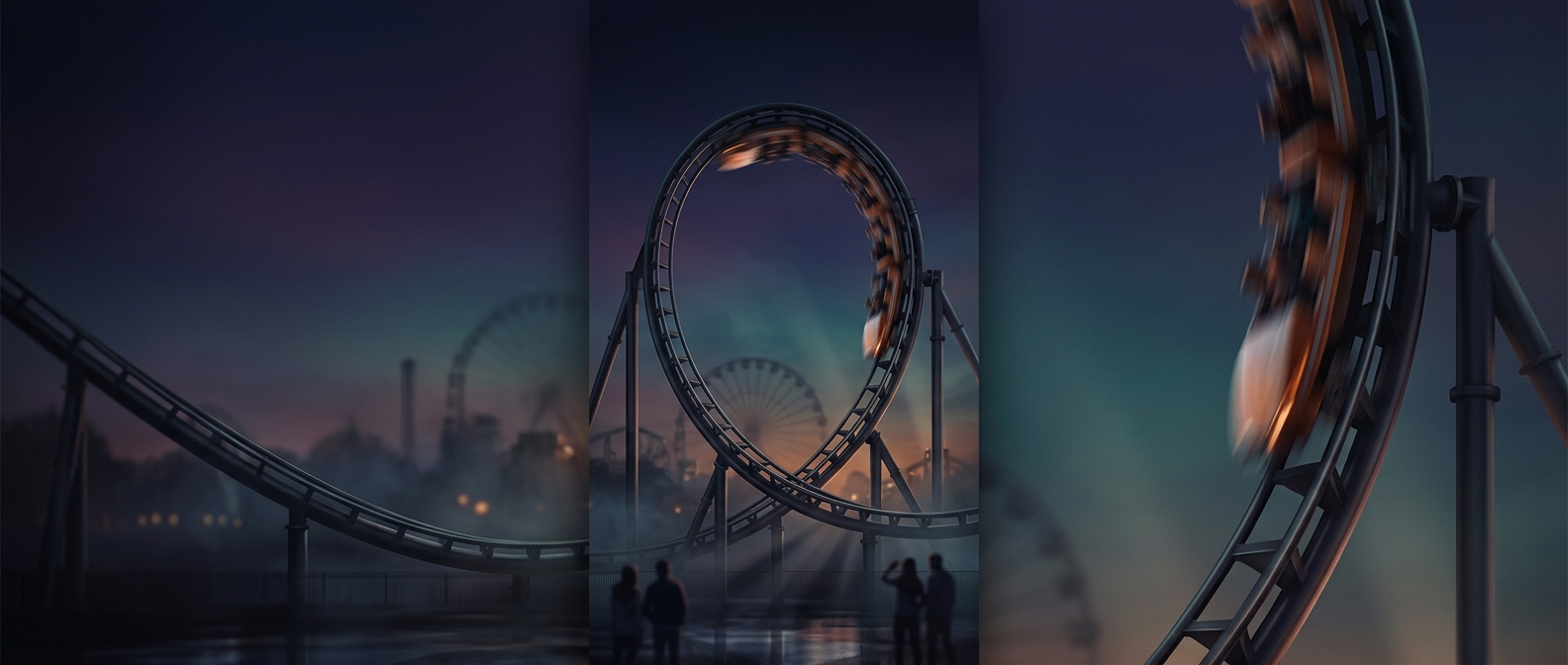
A perfect circle makes the track curve at the same rate everywhere. That sounds smooth, but a coaster does not travel at the same speed everywhere: it is moving fastest near the bottom of a loop and slows as it climbs. At high speed, forcing a train around a tight curve requires a large inward acceleration. Riders feel that as a heavy push into their seats.
A circular loop would therefore create its greatest strain where the train is moving fastest—often an uncomfortable or unsafe combination. Simply making the whole circle larger would ease that force, but could make the loop too tall to fit the ride’s speed and layout.
A Shape That Matches the Train’s Speed
A clothoid, or teardrop-shaped loop, changes curvature gradually. It spreads out near the bottom, where the train is fast, then tightens toward the top, where the train has slowed. Curvature means how sharply a path bends; a tighter curve has greater curvature and demands more acceleration at a given speed.
The track’s changing shape helps balance speed against bend: a broad lower section moderates the forces at the train’s fastest point, while the tighter upper section lets the loop turn back within a more practical height. The transition also avoids asking the train—and its riders—to shift suddenly from straight track into a sharply bending path.
The key is not that the teardrop eliminates forces, but that it puts the sharper turn where the train is moving more slowly. That is why a loop can look almost circular from a distance while its carefully stretched lower half makes the ride far more manageable.