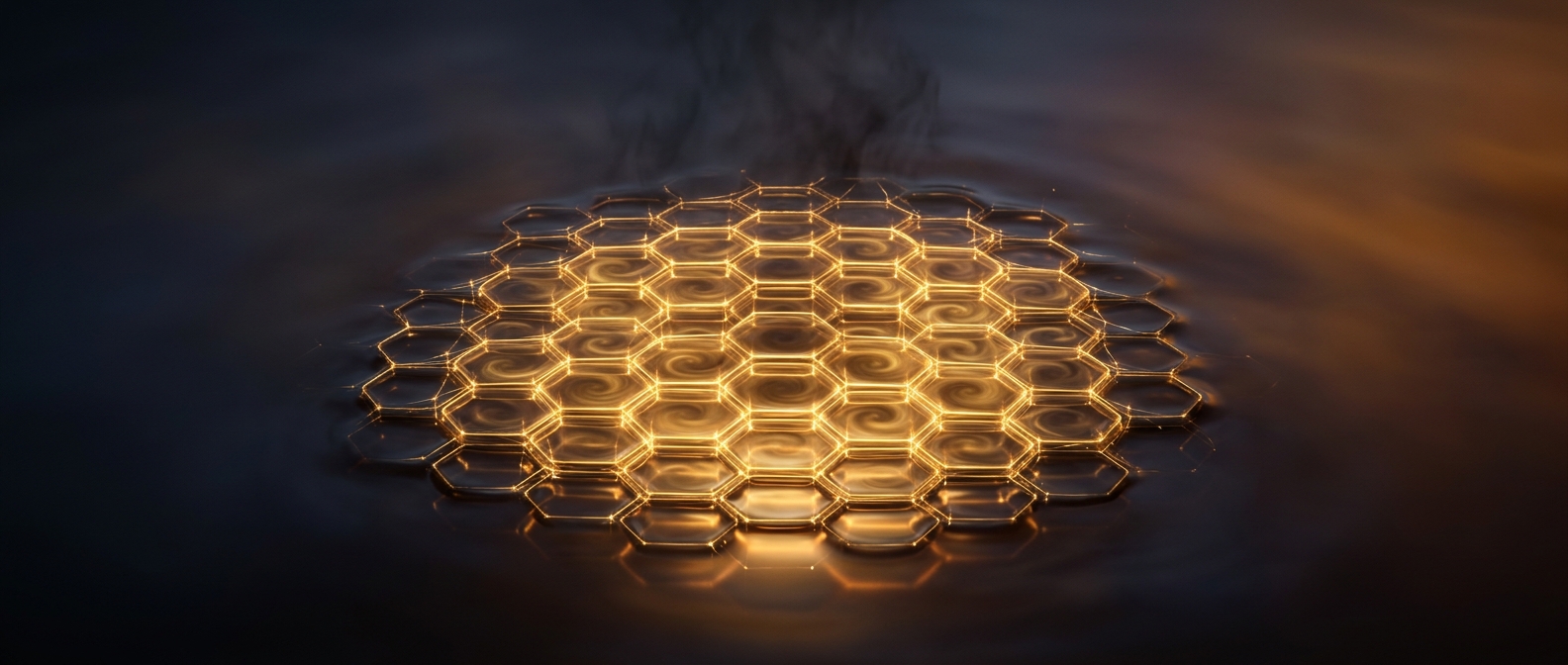
How heat turns a quiet layer into moving cells
A liquid warmed from below can become unstable: fluid near the bottom heats up, expands, and becomes less dense than the cooler fluid above it. Buoyancy pushes the warm liquid upward, while cooler, denser liquid sinks to take its place. This circulation is called convection—heat carried by the bulk movement of a fluid rather than passed along only by molecule-to-molecule conduction.
The change does not begin at just any temperature difference. At first, viscosity—the liquid’s resistance to flowing—and heat conduction can smooth out disturbances. Once buoyancy is strong enough to overcome those effects, small motions grow into organized currents.
Why the flow can form a honeycomb
As warm fluid rises and cool fluid descends, the motion divides the layer into neighboring circulation cells. Their boundaries mark places where flow turns or changes direction. Under some combinations of fluid properties, layer depth, and heating, those cells arrange in a roughly hexagonal pattern. The six-sided outlines help the cells fit together across a flat surface, much as hexagons tile a plane; they are a possible pattern, not a shape every convecting liquid must adopt.
The pattern is a snapshot of a dynamic process. Individual cells can shift, merge, or break apart as the temperature and flow change. In a shallow transparent layer, suspended particles or changes in temperature can make the circulating regions visible from above.
Heat leaves a visible pattern
Convection cells matter because their arrangement changes how efficiently heat moves through a fluid. Instead of warming the liquid only through slow conduction, rising and sinking currents transport heat across the layer. The honeycomb is therefore more than a surface decoration: it is the visible footprint of heat reorganizing the fluid’s motion.