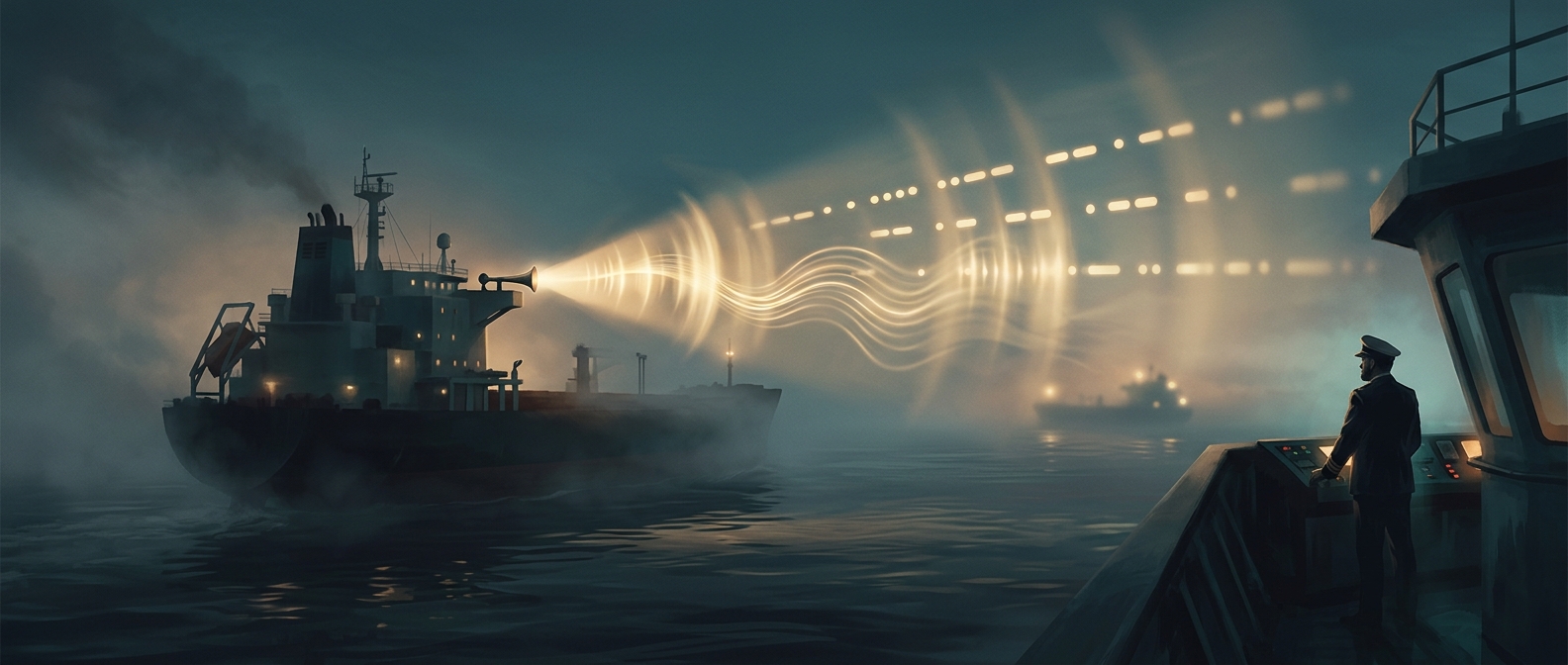
A ship’s horn turns a maneuver into a signal
At sea, a horn blast is not just a louder version of a car horn. In situations covered by international collision-prevention rules, ships can use short blasts to tell nearby vessels what maneuver they intend to make. The pattern is a compact code: one short blast signals a turn to starboard—the ship’s right; two signal a turn to port; three indicate that the ship is operating astern propulsion, pushing water forward to slow or move backward.
That last signal describes what the engines are doing, not necessarily a complete reverse of the ship’s course. A large vessel has momentum, and changing its direction or speed can take time. The blast gives another vessel advance notice while the maneuver unfolds.
Why the code matters in close quarters
The signals make intentions audible when watching another ship’s position alone may not be enough. A vessel can be turning gradually, or its movement can be hard to judge against the water and shoreline. A brief, standardized pattern helps crews share what they plan to do without relying on a radio conversation.
A rapid series of at least five short blasts serves a different purpose: it signals that a vessel does not understand another ship’s intentions or doubts that the other vessel is taking sufficient action to avoid danger. It is an alert, not a substitute for maneuvering to stay clear.
The practical consequence is that a few seconds of sound can prompt a crew to reassess a developing crossing or close pass—before a ship’s slow, powerful movement becomes difficult to change.